

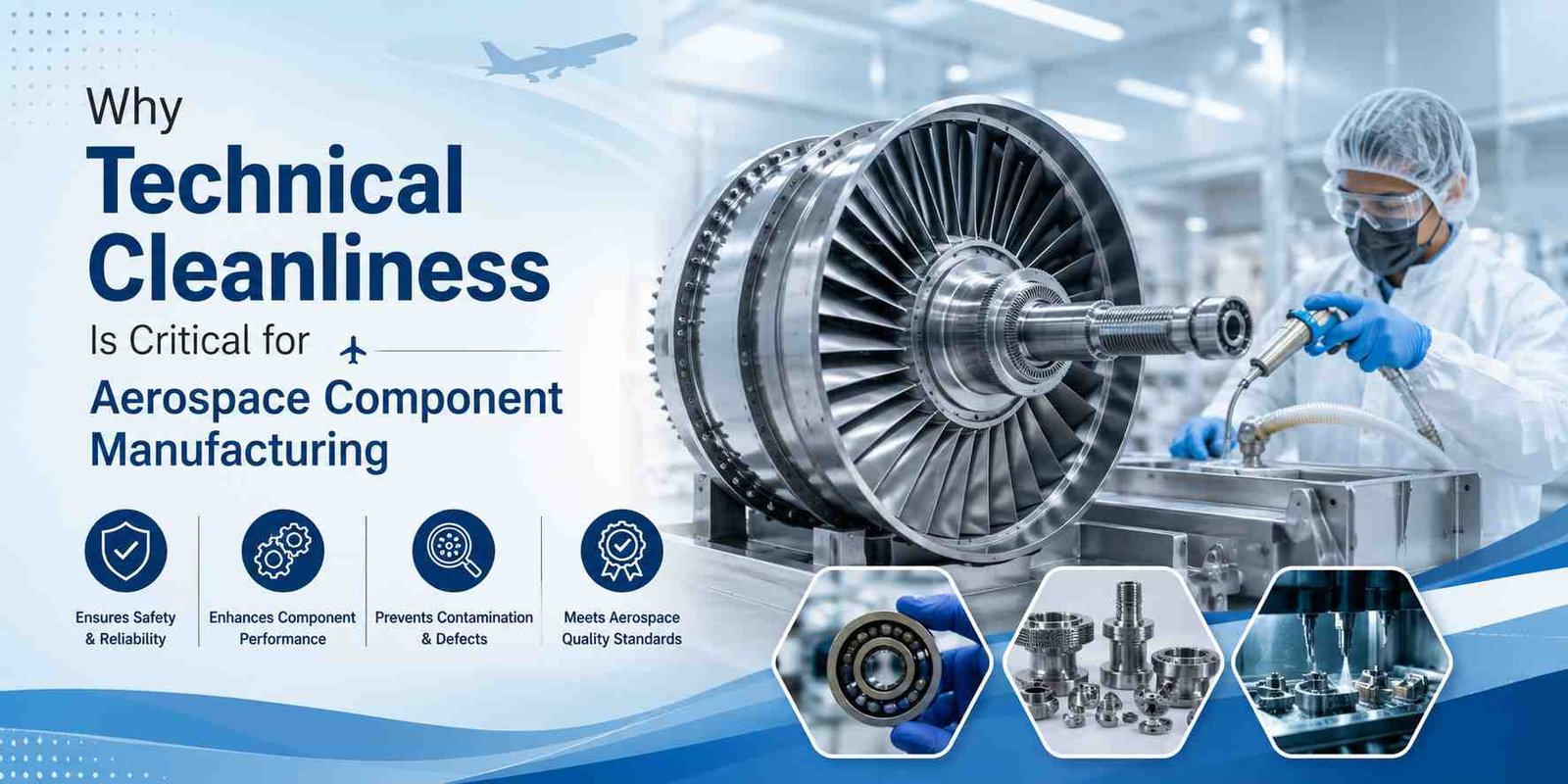
In aerospace manufacturing, even microscopic contamination can compromise component reliability, safety, fatigue life and downstream processes. Technical cleanliness is not a final washing step; it is an integral part of the production process that directly influences performance under extreme operating conditions.
Modern aerospace components must deliver absolute precision. Whether flying at high altitudes, operating in defence environments or supporting space missions, these parts face intense mechanical stress, temperature extremes and zero-tolerance safety requirements. Cleanliness is therefore as critical as dimensional accuracy.
Aerospace manufacturing spans several high-stakes segments:
- Commercial aviation
- Defence
- Space
- Helicopters
- Drones
In every segment, uncontrolled contamination can lead to assembly failures, reduced component life, system malfunctions or costly rework.
Why Technical Cleanliness is Essential
Aerospace systems contain intricate components where residual particles or filmic residues can cause serious functional issues.
Key cleaning applications include:
- Propulsion System (Engine Components) – Turbine blades, fuel injectors and combustion chamber parts require ultra-clean surfaces to prevent performance loss and thermal damage.
- Flight Control System – Actuators and control mechanisms must remain free of particles that could cause sticking or inaccurate response.
- Landing Gear System – High-load components need thorough degreasing and particle removal to maintain structural integrity and prevent premature wear.
- Fuel System – Contaminants in fuel lines or pumps can lead to blockages, corrosion or engine inefficiency.
- Hydraulic & Pneumatic Systems – Even fine particles can damage seals, valves and pumps, resulting in system failure.
- Electrical & Avionics Systems – Cleanliness protects sensitive electronics from short circuits or signal interference.
- Environmental Control System (ECS) – Cabin air and thermal management components demand high purity levels.
- Fasteners & Small Components – Tiny parts often carry residual machining debris that can migrate into critical assemblies.
Inadequate cleanliness leads to assembly failures, reduced component reliability, increased maintenance costs and potential safety risks. In aerospace, these consequences are unacceptable.
Sources of Contamination
Contamination in aerospace manufacturing generally falls into two categories:
Particulate Contamination
- Machining chips
- Grinding particles
- Abrasive residues
- Polishing compounds
These solid particles can embed in surface features, block narrow passages or cause abrasive wear during operation.
Filmic Contamination
- Machining oil
- Coolant residues
- Fingerprints
- Cleaning process residues
Filmic layers interfere with coating adhesion, bonding and surface treatments. They can also attract additional particles and accelerate corrosion.
Both types of contamination must be controlled throughout the manufacturing chain, not only at the final cleaning stage.
What Is Technical Cleanliness?
Technical cleanliness refers to the systematic control of contamination on manufactured components to ensure they meet defined cleanliness requirements before the next production stage.
Unlike visual cleanliness, where a component simply appears clean, technical cleanliness focuses on contamination that is often invisible to the naked eye but can significantly affect product performance and reliability.
The acceptable cleanliness level depends on the component’s application, customer specifications, and industry requirements.
Technical Cleanliness Standards
Aerospace manufacturers follow rigorous cleanliness standards to ensure consistent quality and safety.
- ISO 16232 defines the methodology for extracting and analysing particulate contamination on components.
- VDA 19 provides complementary guidelines widely used in high-precision industries.
These standards specify how contamination is extracted (e.g., through controlled rinsing or ultrasonic methods) and how particles are measured by size, quantity and type. Cleanliness limits themselves are application-specific and often defined by aerospace OEMs or customer specifications.
Many aerospace companies maintain internal cleanliness specifications that go beyond industry standards. These may include stricter particle size limits, maximum particle counts or requirements for filmic residue control prior to coating, assembly or testing.
Meeting these requirements demands validated cleaning processes and reliable measurement methods such as Millipore testing and automated particle analysis.
Ecoclean Solution for Aerospace Cleanliness
Ecoclean India supports aerospace manufacturers with a complete technical cleanliness approach that integrates process development, validation and measurement.
Through the India Technology Centre in Pune, Ecoclean offers:
- Cleaning trials under production-like conditions
- Process validation
- Millipore testing
- Particle analysis using advanced microscope and particle scanner
- Expert consultation on ISO 16232 / VDA 19 compliance
Ecoclean provides a range of Made-in-India cleaning technologies suitable for aerospace applications, including:
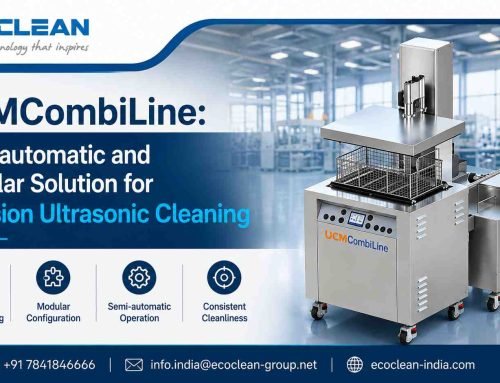
- UCMCombiLine – Modular ultrasonic precision cleaning systems ideal for high-cleanliness requirements
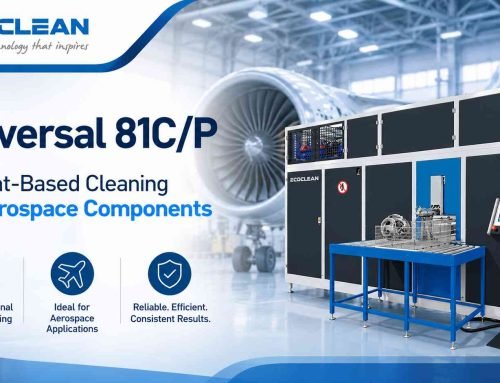
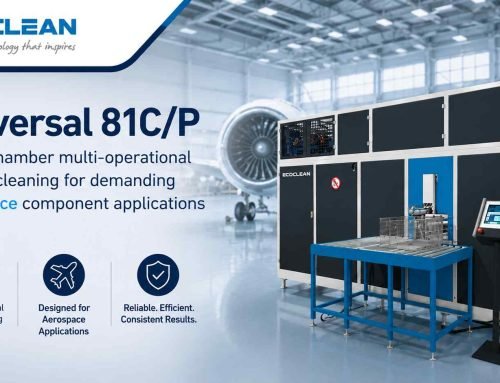
- Universal 81C, EcoCcompact and Minio 85C – Solvent-based systems for effective degreasing of complex geometries
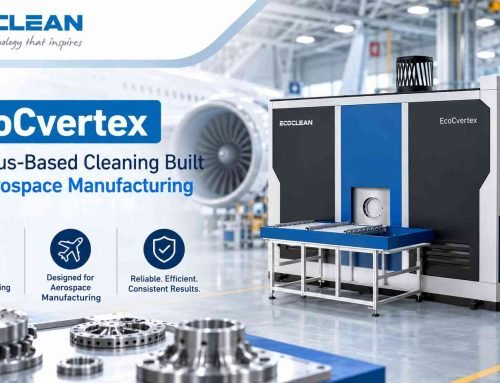
- EcoCvertex and EcoCmini – Advanced aqueous cleaning solutions for environmentally conscious and high-performance cleaning
These systems can be configured for multi-stage processes that combine cleaning, rinsing and drying to achieve the required cleanliness levels consistently.
Conclusion
Technical cleanliness is a fundamental quality parameter in aerospace component manufacturing. Contamination control protects reliability, extends fatigue life, ensures assembly integrity and supports compliance with stringent industry and OEM requirements.
By treating cleanliness as an integral part of the production process supported by validated cleaning technology and precise measurement, aerospace manufacturers can reduce risk and deliver components that perform safely under the most demanding conditions.
Ready to validate your aerospace cleaning process?
Contact the Ecoclean India Application Team to schedule a cleaning trial and particle analysis at the Pune Technology Centre.