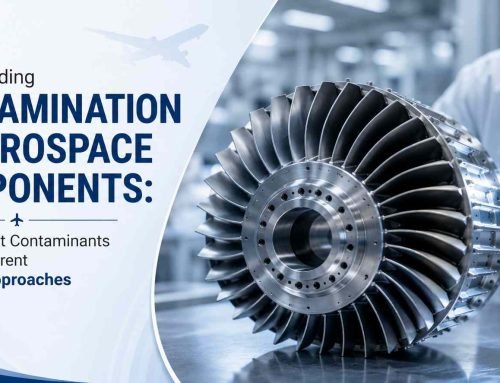


Anyone who has spent time on an aerospace shop floor knows that “clean” means something very different here than it does anywhere else in manufacturing. A turbine blade or a hydraulic fitting doesn’t just need to look free of grease, it needs to be certifiably free of particulate contamination down to a documented, traceable level. Get that wrong and you’re not looking at a cosmetic defect. You are looking at a part that can fail in service.
Aerospace components can be subject to stringent cleanliness requirements, particularly where particulate contamination may affect sensitive assemblies, hydraulic systems, fuel systems or other precision applications. Visual inspection alone cannot establish technical cleanliness; contamination levels must be evaluated against defined specifications and appropriate inspection methods.
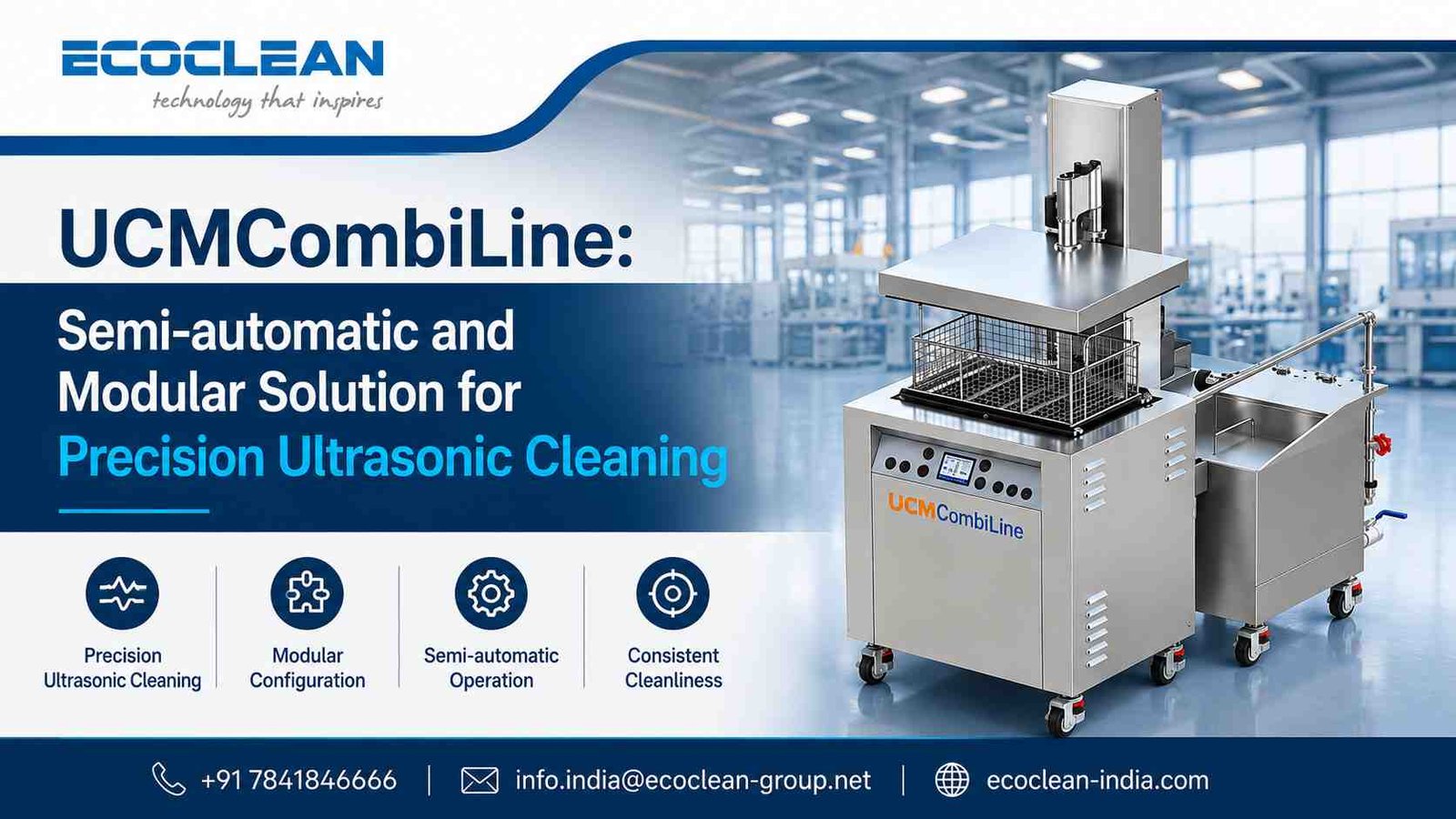
 UCMCombiLine – ultrasonic cleaning machine with self-sufficient individual stations, built for cleaning of small-sized parts efficiently – across all industries.
Why Aerospace Cleaning Is a Different Category of Problem
In most industries, a cleaning process gets judged by whether a part looks and feels clean. In aerospace, that standard doesn’t hold up. Contamination that’s invisible to the eye finen metal particles left over from machining, residual cutting fluid trapped in a blind hole, fibers from a handling cloth can still compromise a component’s function or its certification status. Add in the range of materials aerospace manufacturers work with (titanium alloys, nickel-based superalloys, aluminum, composites) and the geometric complexity of parts like manifolds, fuel system components and turbine hardware and you end up with a cleaning challenge that a generic wash tank simply isn’t built to handle.
This is where ultrasonic cleaning earns its place. Ultrasonic cleaning uses cavitation generated within the cleaning medium to support the removal of fine contamination from component surfaces and difficult-to-access geometries. This can be particularly useful for components containing internal passages, recesses and other intricate features.
What the UCMCombiLine Actually Brings to the Table
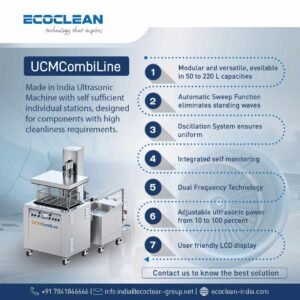
The UCMCombiLine is a modular, ultrasonic cleaning machine built with self-sufficient individual stations, designed specifically for components that carry high cleanliness requirements.
Here’s what’s actually under the hood:
- Modular and versatile capacity: available from 50 to 220 litres, so the same platform scales from smaller precision components to larger batch runs without switching machines.
- Automatic Sweep Function: eliminates standing waves inside the tank, which matters because standing waves create uneven cleaning zones. Without sweep, some surfaces on a part get thoroughly cleaned while others barely get touched.
- Oscillation System: Supports improved and more uniform ultrasonic distribution within the tank.
- Integrated self-monitoring: supports consistent process control and adaptation to changing loads
- Dual-frequency technology: different frequency combinations are available and can be selected according to the cleaning application.
- Adjustable ultrasonic power, 10 to 100 percent: ultrasonic power can be adjusted from 10–100%, allowing the process to be configured according to the component and cleaning requirement.
- User-friendly LCD display: process settings are visible and controllable at the machine, not buried in a separate system operators have to reference separately.
The point of building it this way wasn’t to make the most powerful machine on paper. It was to make one that could be tuned to the part in front of it, because aerospace production rarely deals with a single, uniform contamination challenge across every component that comes down the line.
Consistency Is the Part People Underestimate
For precision cleaning, repeatability is as important as initial cleaning performance. Process parameters need to remain controlled despite variations in component loading and operating conditions. Features such as automatic sweep, oscillation, adjustable ultrasonic power and integrated self-monitoring are therefore important for maintaining consistent ultrasonic cleaning conditions. Features like the Automatic Sweep Function, integrated self-monitoring and adjustable power aren’t there to look good on a spec sheet; they’re there so a manufacturer can point to a documented, repeatable process rather than one that depends on how thorough today’s operator happened to be.
Ecoclean India can conduct application-specific cleaning trials and cleanliness evaluations using actual components to help determine whether the selected process can meet the defined cleanliness requirements. like ISO 16232 or VDA 19.
Where This Fits Into Your Process
The appropriate ultrasonic cleaning process depends on component geometry, contamination characteristics, cleanliness requirements and production conditions. Ecoclean India can support application-specific evaluation and process development to determine the appropriate UCMCombiLine configuration for the component and cleaning task.
Our UCMCombiLine product page has the full technical specifications and our aerospace applications page covers how we’ve approached cleaning for other component types in this sector. If you’d rather talk through your specific part and contamination profile directly, that’s usually the faster route.
Looking for the right cleaning solution for your aerospace components? Talk to Ecoclean India for application-specific cleaning solutions.
📞 Call: +91-7841846666
📧 Email: info.india@ecoclean-group.net
🌐 Visit: ecoclean-india.com
Contact Us to Know the Best Solution →
Ecoclean India is part of the SBS Ecoclean Group, manufacturing precision parts cleaning systems from our Pune facility since 2008, with in-house testing and validation against ISO 16232 and VDA 19 standards.