

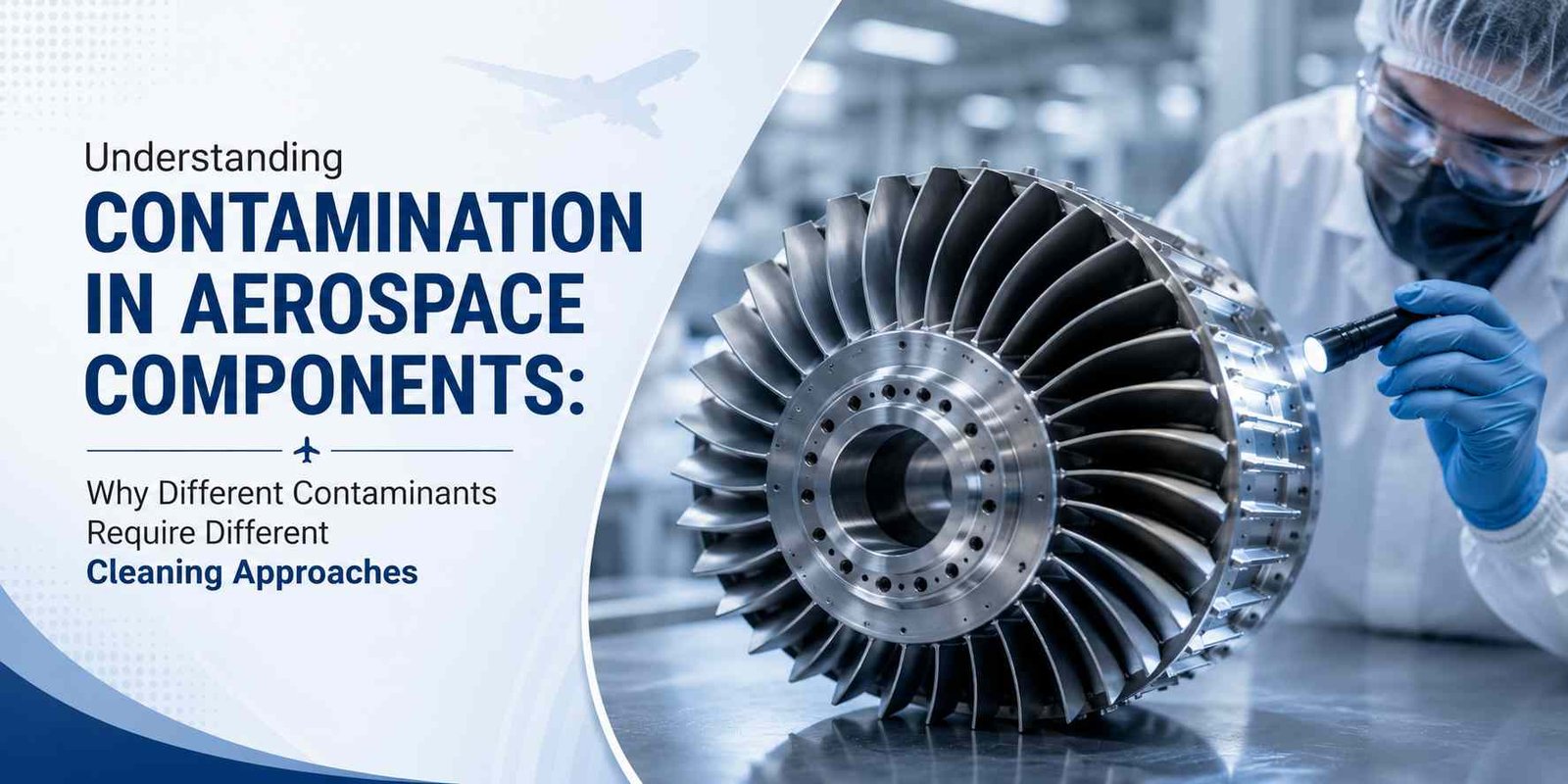
Every aerospace component undergoes multiple manufacturing operations before final assembly. Processes such as turning, milling, grinding, honing, EDM, deburring, surface finishing and heat treatment each introduce specific types of contamination.
Because these contaminants differ in nature, size and adhesion strength, a single cleaning method cannot deliver consistent technical cleanliness. Understanding the contamination is therefore the essential first step in designing an effective industrial parts cleaning process.
At Ecoclean India, we approach cleanliness as an application engineering challenge. We select the cleaning technology, chemistry and process parameters based on the actual contamination characteristics rather than simply recommending a standard machine.
Not All Contamination Is the Same
Contamination in aerospace components generally falls into two main categories.
Particulate Contamination
Solid particles generated during machining and finishing operations include:
- Metal chips
- Grinding particles
- Abrasive media
- Dust
- Carbon particles
- Burrs
These particles can lodge in tight tolerances, blind holes, internal passages and surface features. Even small quantities can cause wear, blockage or functional failure during operation.
Filmic Contamination
Thin residual layers that adhere to the surface include:
- Cutting oils
- Coolants
- Corrosion inhibitors
- Grease
- Polishing compounds
- Fingerprints
Filmic residues interfere with coating adhesion, bonding and subsequent manufacturing steps. They can also attract additional particles and reduce the effectiveness of later cleaning stages.
Important: Visual cleanliness does not guarantee technical cleanliness. A component that looks clean to the naked eye may still carry particles or filmic layers that exceed aerospace cleanliness limits defined by ISO 16232, VDA 19 or customer-specific specifications.
Why One Cleaning Process Does Not Fit All
The correct cleaning approach depends on several factors:
- Type of contamination (particulate or filmic)
- Level of contamination
- Component geometry (simple surfaces vs. complex internal features)
- Material compatibility
- Required cleanliness specification
- Downstream processes (coating, assembly, testing, etc.)
Selecting the wrong process can leave residual contamination, damage sensitive surfaces or increase process cost without improving results.
Selecting the Appropriate Cleaning Technology
Different contaminants and geometries respond best to specific cleaning methods.
Effective for removing loose particles from relatively simple geometries. High-pressure spray can flush away chips and debris from accessible surfaces.
Immersion Cleaning with Ultrasonic Assistance
Ideal for complex parts that contain blind holes, intricate passages and sticky contaminants. Ultrasonic cavitation reaches areas that spray cannot access.
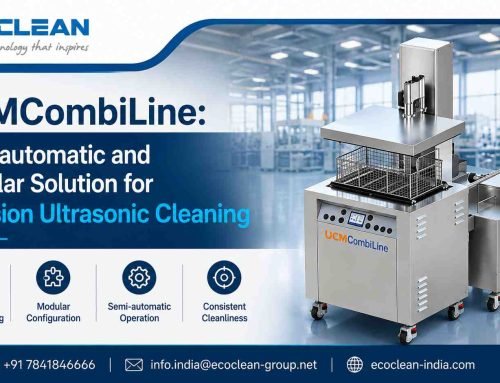
Ecoclean’s UCMCombiLine modular ultrasonic systems are particularly suited for precision aerospace components requiring high cleanliness levels.
Solvent Cleaning
Highly effective for removing mineral oils, preservation oils and achieving residue-free drying. Solvent processes are often preferred when filmic contamination must be eliminated completely.
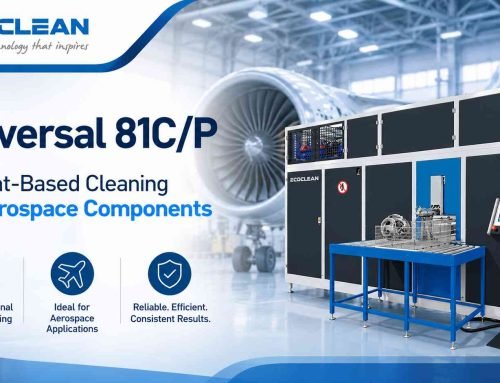
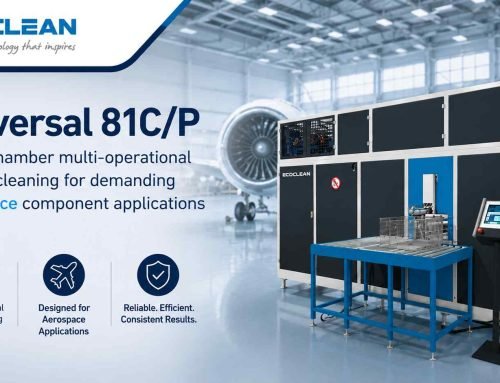
Suitable Ecoclean solutions include the Universal 81C, EcoCcompact and compact Minio 85C.
Aqueous Cleaning
Well suited for coolant emulsions and particulate contamination when environmental and process requirements favour water-based chemistry.
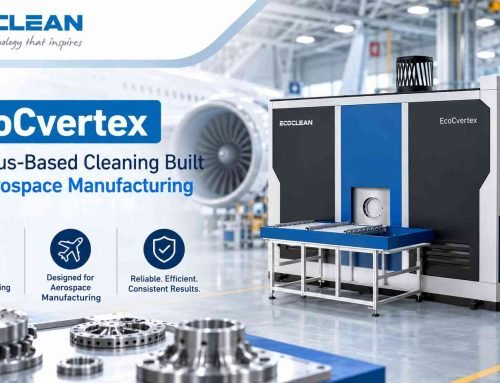
The EcoCvertex and other aqueous systems from Ecoclean deliver efficient cleaning with optimised fluid management for fine and intermediate cleanliness levels.
In practice, many aerospace applications benefit from multi-stage processes that combine immersion, ultrasonics, spray and appropriate drying methods to address both particulate and filmic contamination.
Process Validation: The Ecoclean Differentiator
Selecting the right technology is only part of the solution. The process must be validated under real conditions.
At the Ecoclean India Technology Centre in Pune, we support aerospace manufacturers through:
- Cleaning trials on actual customer components
- Millipore testing
- Detailed particle analysis
- Full process validation against target cleanliness specifications
This application engineering approach ensures that the recommended cleaning process consistently meets the required technical cleanliness standards before the machine is installed in production.
Conclusion
Different contaminants behave differently and therefore demand different cleaning technologies, chemistries and process parameters. Treating all contamination the same way risks incomplete cleaning, higher costs or non-compliance with aerospace requirements.
By analysing the specific contamination characteristics of each component and validating the process through trials and measurement, manufacturers can achieve reliable technical cleanliness and protect component performance.
Need help matching the right cleaning process to your aerospace components?
Contact the Ecoclean India Application Team to schedule a contamination assessment and cleaning trial at the Pune Technology Centre.