

Cleanliness testing for MedTech components: Millipore test, gravimetry, particle analysis and residue analysis
A dental implant or a hip joint component can leave the machining shop looking spotless and still carry contamination you cannot see. That is the difficulty with MedTech parts. They are small, finely finished and close to the human body and the eye is the least reliable tool you have for judging whether they are clean enough.
Anyone who has worked on a cleaning line for medical components knows the pattern. A batch passes visual inspection, then a customer audit or a downstream process such as coating or bonding turns up residue nobody expected. The part was cleaned. Nobody had measured how well.
Two Kinds of Contamination, Two Different Problems
Contamination on a critical surface falls into two groups, and they behave differently.
Particulate contamination is solid matter: metal fines left after machining, abrasive grit, polishing debris, fibres picked up during handling. It can be counted, sized and weighed.
Non-particulate contamination is film and residue: machining oils, greases, coolant emulsion and other soluble residues. A surface can carry a film of oil and show almost no particles at all.
A cleaning process that handles one group well can still fail on the other, so a test plan has to cover both. Residual oils, coolants, metallic particles or polishing compounds can interfere with assembly, coating, welding, bonding and final testing and in MedTech the cost of that interference is higher than in most sectors.
Additional consideration: Organic and biological contamination
In medical device manufacturing, visual cleanliness is not enough. Process residues such as machining oils, polishing compounds and cleaning agents must be reliably removed, and the results must be measurable and documented.
Depending on the component and its intended application, cleanliness evaluation may also need to address organic residues and microbial contamination. Total Organic Carbon (TOC) analysis can help quantify organic carbon in a suitable sample, while bioburden testing can assess microbial contamination before sterilisation where required. Cytotoxicity testing may also be relevant when evaluating whether materials or residual substances produce harmful effects on cells under the conditions of the selected test.
These methods address different questions and are not interchangeable. The appropriate combination depends on the component, the contamination risks, the intended use and the applicable acceptance criteria.
Ecoclean cleanliness analysis and testing for MedTech components Millipore test, gravimetry test, particle analysis and residue analysis
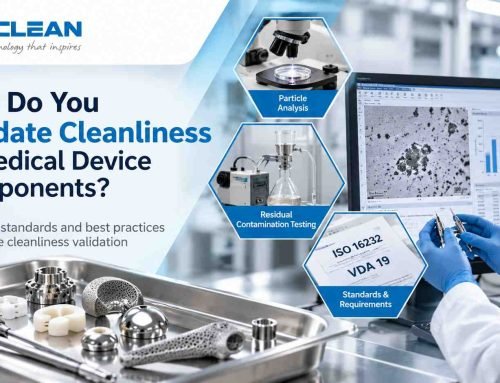
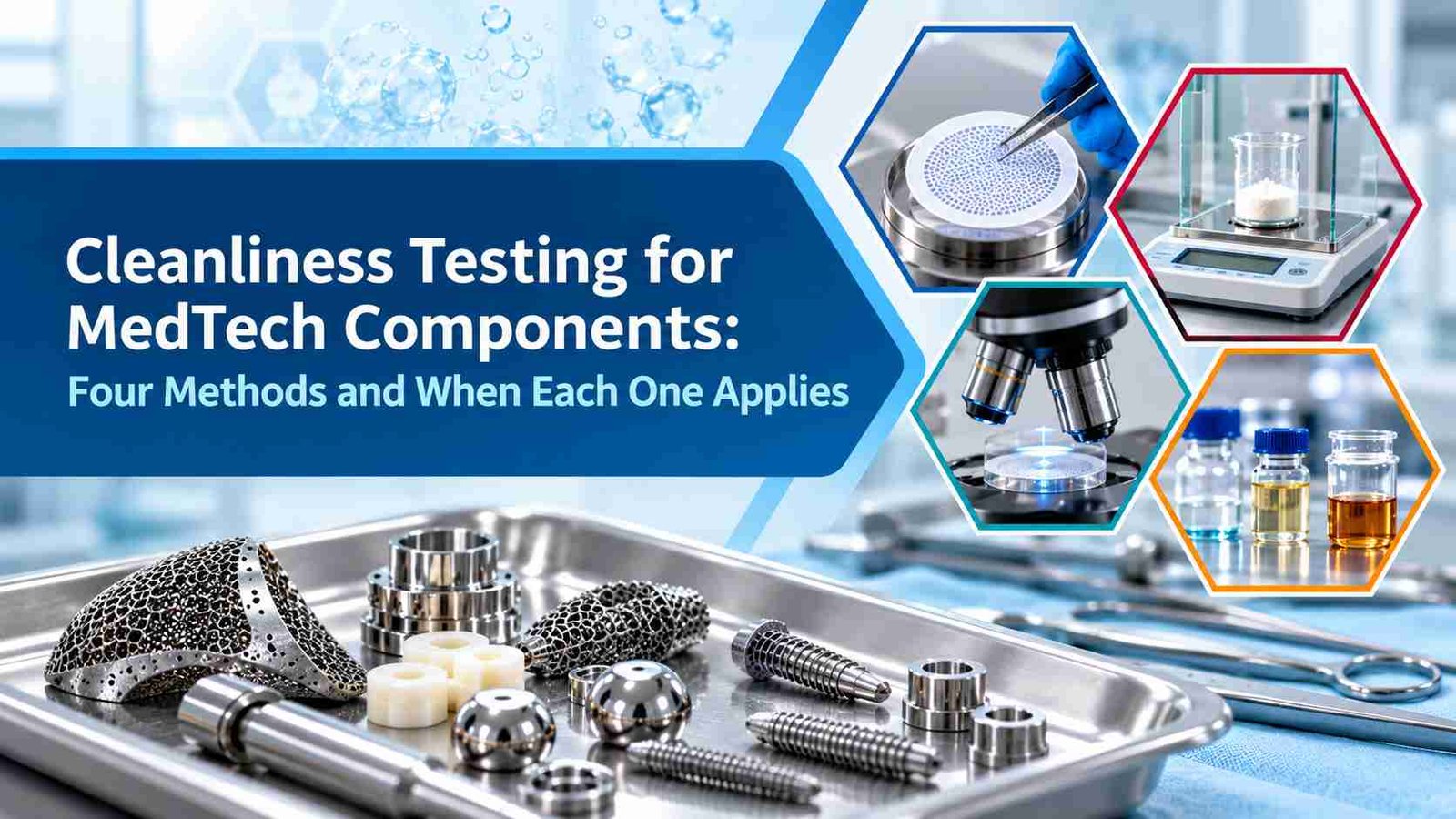
Ecoclean evaluates component cleanliness through four methods: Millipore test, gravimetry test, particle analysis and residue analysis.
The Four Methods Ecoclean Uses to Evaluate Component Cleanliness
| Method | What it tells you | Contamination type |
|---|---|---|
Millipore test |
Captures extracted particles on a membrane filter for further evaluation | Particulate |
| Gravimetry test | The mass of contamination extracted from the component | Particulate |
| Particle analysis | Particle size and particle count | Particulate |
| Residue analysis | Oils, greases and other soluble residues | Non-particulate |
Millipore test
The component is rinsed or extracted, and the liquid is passed through a membrane filter. Whatever was on the part ends up on the filter, where it can be examined. It is a common starting point for technical cleanliness work, and the quality of the result depends heavily on how carefully the extraction is done.
Gravimetry test
Gravimetry weighs what came off the component. You get one number, the total mass of contamination, which is useful for tracking a process over time or comparing two cleaning setups. It does not tell you how many particles there were or how large they were, so it works best alongside the other methods.
Particle analysis
Here the particles on the filter are measured for size and counted. This matters when a specification limits large particles more strictly than small ones, which is common where a single oversized particle on a critical surface is the real risk. Ecoclean’s Technology Centre in Pune carries out particle analysis in line with ISO 16232 and VDA 19.
Particle analysis is also a complementary method when evaluating the cleanliness of medical device components. It provides information about particulate contamination but does not, on its own, establish the level of organic residues or microbial contamination. Other testing methods may be needed when those factors are relevant to the component and its intended use.
Residue analysis
Residue analysis looks at what the filter cannot show oils, greases and other soluble residues. A part can give a clean filter and still carry a thin film from the last machining or cleaning step. For MedTech components that go on to coating or bonding, this is often the test that decides whether the process is really under control.
Additional consideration: Total Organic Carbon (TOC)
Total Organic Carbon (TOC) analysis can be used to quantify organic carbon in a suitable sample. It may help assess organic residues associated with manufacturing or cleaning, provided the method is appropriate for the substances being investigated.
TOC does not automatically identify the specific chemical responsible for the measured carbon or establish that a component is biologically safe. The sampling procedure, analytical method and acceptance criteria must be suitable for the application.
Which Test Do You Need?
The answer starts with your specification, not with the lab. The acceptance limit comes from your customer or your device requirements and a test only reports what is on the part.
Some practical starting points:
- Setting up a new cleaning process: run Millipore extraction with particle analysis first, so you know the size and count of what remains.
- Tracking process stability: add gravimetry, since one mass figure per batch makes drift easy to spot.
- Parts heading for coating, bonding or welding: include residue analysis, because films cause failures that particle counts will not predict.
- Comparing two cleaning technologies: use the same extraction and the same methods on both, so the results can be set side by side.
For medical device components, additional testing may be appropriate depending on the intended use and the contamination risks being assessed:
- TOC testing: Consider when quantifying organic carbon is relevant to evaluating residual contamination.
- Bioburden testing: Consider when microbial contamination must be assessed before sterilisation or as part of the applicable manufacturing requirements.
- Cytotoxicity testing: Consider when evaluating potential harmful cellular responses associated with a material, extract or relevant residual substance.
- Particle analysis: Use as part of the assessment of particulate contamination, alongside other methods where required.
Not every component requires every test. The appropriate testing plan should be based on the component’s intended application, risk assessment, customer requirements and applicable acceptance criteria.
Cleaning-Process Qualification and Validation
Cleanliness testing provides information about contamination on a component under defined test conditions. Cleaning-process validation addresses a broader question: whether the cleaning process can consistently achieve the required outcome under its intended manufacturing conditions.
A satisfactory result from a single component or trial does not automatically demonstrate that a cleaning process will remain effective across production batches. A structured approach should consider the cleaning equipment, operating parameters, component characteristics, test methods, acceptance criteria and production conditions.
Installation Qualification (IQ), Operational Qualification (OQ) and Performance Qualification (PQ) are commonly used stages in equipment and process qualification:
- Installation Qualification (IQ): Documents that the equipment and its installation have been checked against defined specifications.
- Operational Qualification (OQ): Evaluates whether the equipment operates as intended within specified operating conditions.
- Performance Qualification (PQ): Evaluates whether the process achieves the required performance under defined conditions representative of its intended use.
These activities should be supported by appropriate testing, documented results and acceptance criteria. The qualification and validation plan depends on the equipment, process, quality system and requirements applicable to the medical device.
Relevant Standards: ISO 19227 and ASTM F3127
Standards can provide a framework for developing and validating cleaning processes, but their applicability depends on the medical device and manufacturing context.
ISO 19227 addresses cleanliness of orthopaedic implants and provides requirements relevant to their cleaning processes. ASTM F3127 provides guidance on validating cleaning processes used in the manufacture of medical devices.
Manufacturers should determine which standards apply to their particular product and process rather than assuming that the same standard or acceptance criteria apply to every medical device component.
Cleaning-process validation should connect the applicable requirements with the selected test methods, defined acceptance criteria and evidence gathered under representative production conditions.
Test First, Then Choose the Machine
It is common to buy cleaning equipment first and find its limits on the production floor. At Ecoclean India’s Technology Centre in Pune, manufacturers can try different cleaning technologies on their own components, run Millipore tests to measure residual contamination and see results before committing to a machine. That order saves a lot of trial and error.
For precision and medical or optical components, the UCMCombiLine is the modular ultrasonic system in the range, available from 50 to 220 litres with dual-frequency options. If you are still weighing technologies, our guides on aqueous versus solvent cleaning and selecting the right industrial parts cleaning system cover the decision step by step. The Technology Centre page explains how trials are arranged and the Applications page shows how other sectors approach the same problem.
Cleaning trials can help manufacturers compare process options and assess whether a proposed cleaning technology is suitable for their components. Where formal validation is required, further qualification activities, appropriate cleanliness testing and documented evaluation under representative production conditions may be necessary.
Need to evaluate the cleanliness of your MedTech components? Speak to the Ecoclean India team about the right test method for your component.
📞 Call: +91-7841846666
📧 Email: info.india@ecoclean-group.net
Evaluate Component Cleanliness with Ecoclean →
Frequently Asked Questions
1. What is the difference between particulate and non-particulate contamination?
A. Particulate contamination is solid matter such as metal fines, grit or fibres and it can be counted, sized and weighed. Non-particulate contamination is film and residue, mainly oils, greases and soluble residues. They need different test methods, which is why a full cleanliness plan usually includes both.
2. Is a Millipore test enough on its own?
A. For particles, it is the foundation. It will not report oils, greases or soluble residues, so a clean filter does not prove a clean surface. Residue analysis covers that gap.
3. What does gravimetry show that particle analysis does not?
A. Gravimetry gives the total mass of contamination extracted from the component. Particle analysis gives size and count. One tells you how much, the other tells you what kind and together they give a fuller picture.
4. Do I need all four tests for every MedTech component?
A. Not necessarily. The right set depends on what the part does, what happens to it next and what your specification asks for. Start from the specification, then choose the methods that prove each requirement.
5. Can I test my parts before buying a cleaning machine?
A. Yes. Ecoclean India’s Technology Centre in Pune lets manufacturers run cleaning trials and Millipore tests on their actual components before making a purchase decision.