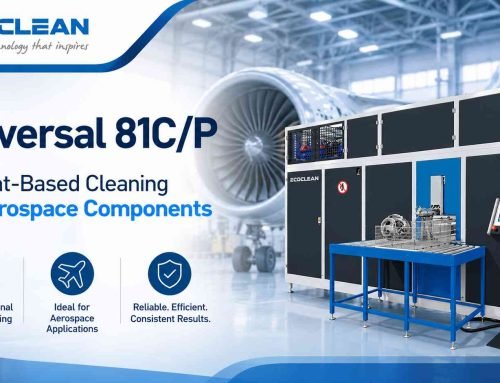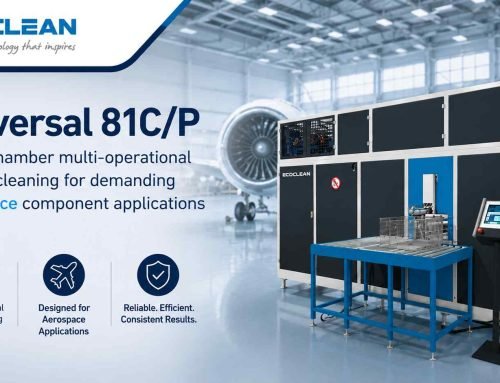


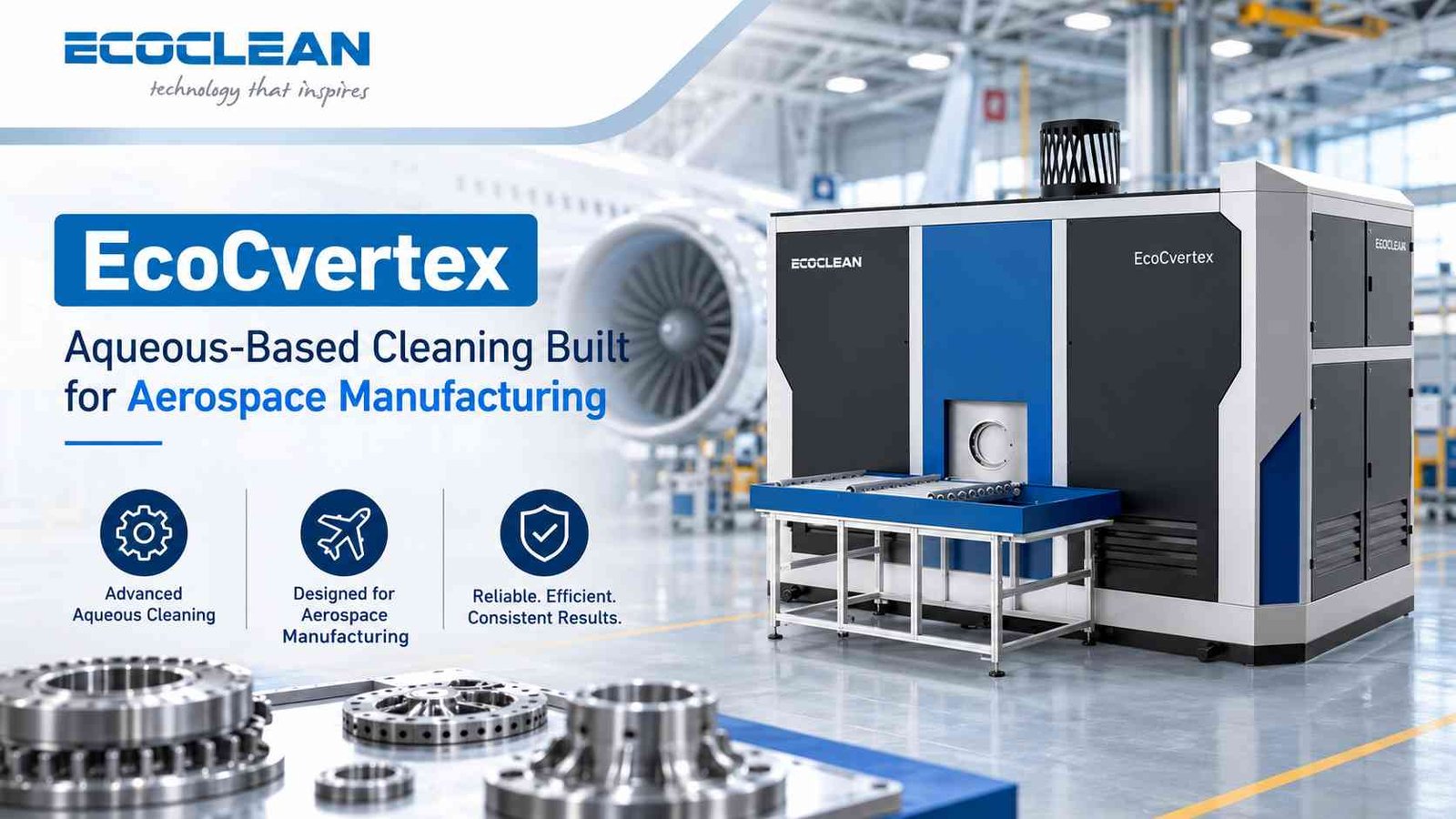
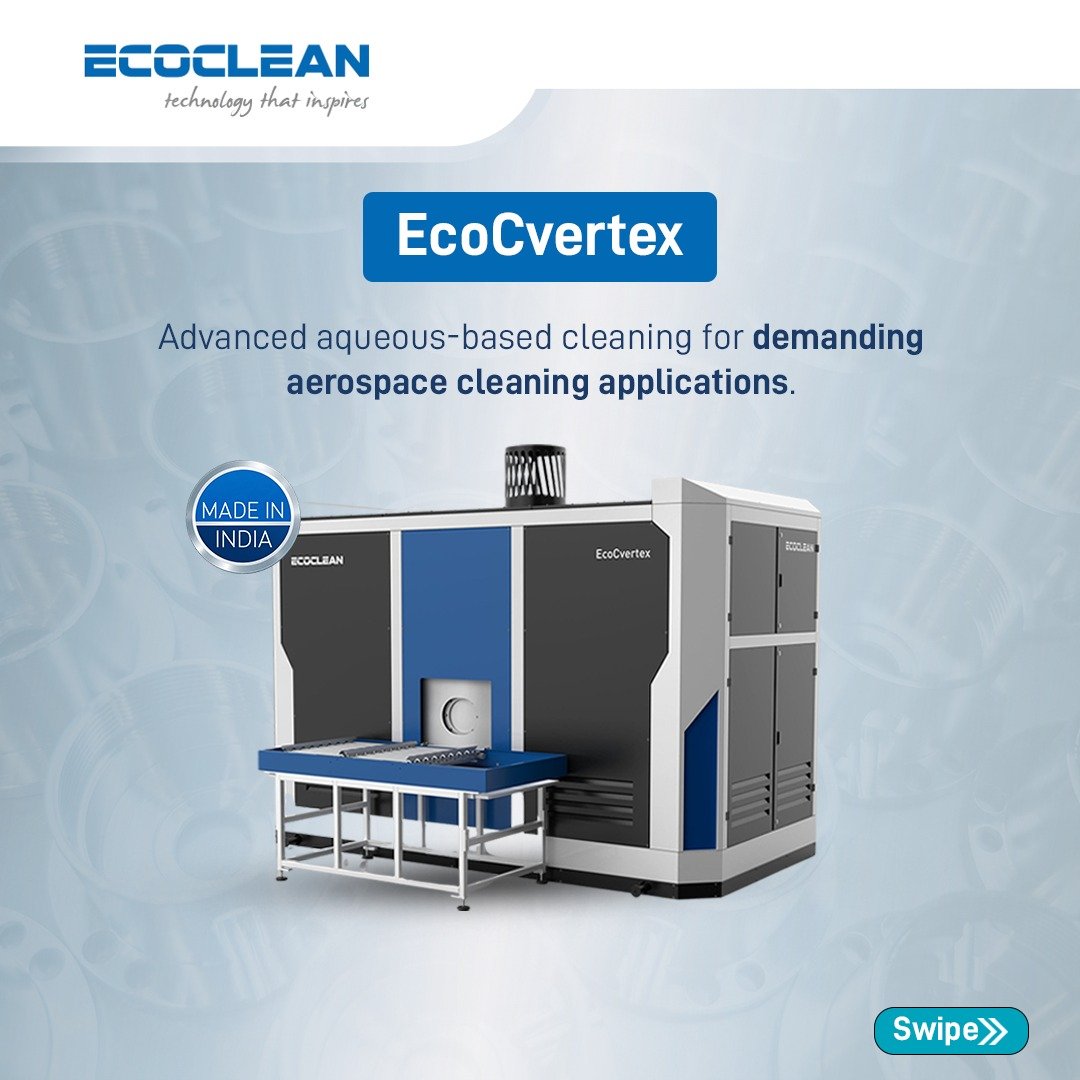
EcoCvertex — advanced aqueous-based cleaning for demanding aerospace cleaning applications.
Aqueous cleaning can be an effective solution for aerospace components when the contamination profile, material compatibility, cleanliness requirements and downstream process are suitable for water-based cleaning. The key is not whether a process uses water or solvent, but whether the complete cleaning process is engineered to achieve the required result consistently.
EcoCvertex, an advanced aqueous cleaning system made in India, is designed around this principle. Its multi-stage cleaning approach combines washing, rinsing and drying with controlled fluid management and filtration, making it suitable for demanding production environments where cleaning consistency is critical.
What Makes an Aqueous Cleaning Process Effective?
Aqueous cleaning is more than immersing a component in a tank of water and cleaning agent or spraying media on the part’s surface. Process performance depends on several parameters working together, including cleaning chemistry, temperature, process time, fluid movement, filtration and drying.
During manufacturing, components may carry machining oils, coolants, emulsions and particulate contamination. As these contaminants are removed, they can accumulate in the process fluid. Effective bath management and filtration therefore become important to maintain cleaning performance and reduce the possibility of contaminants being carried back onto subsequently cleaned components.
This is where the design of the cleaning system becomes as important as the cleaning chemistry itself.
Inside the EcoCvertex: The Engineering That Does the Work
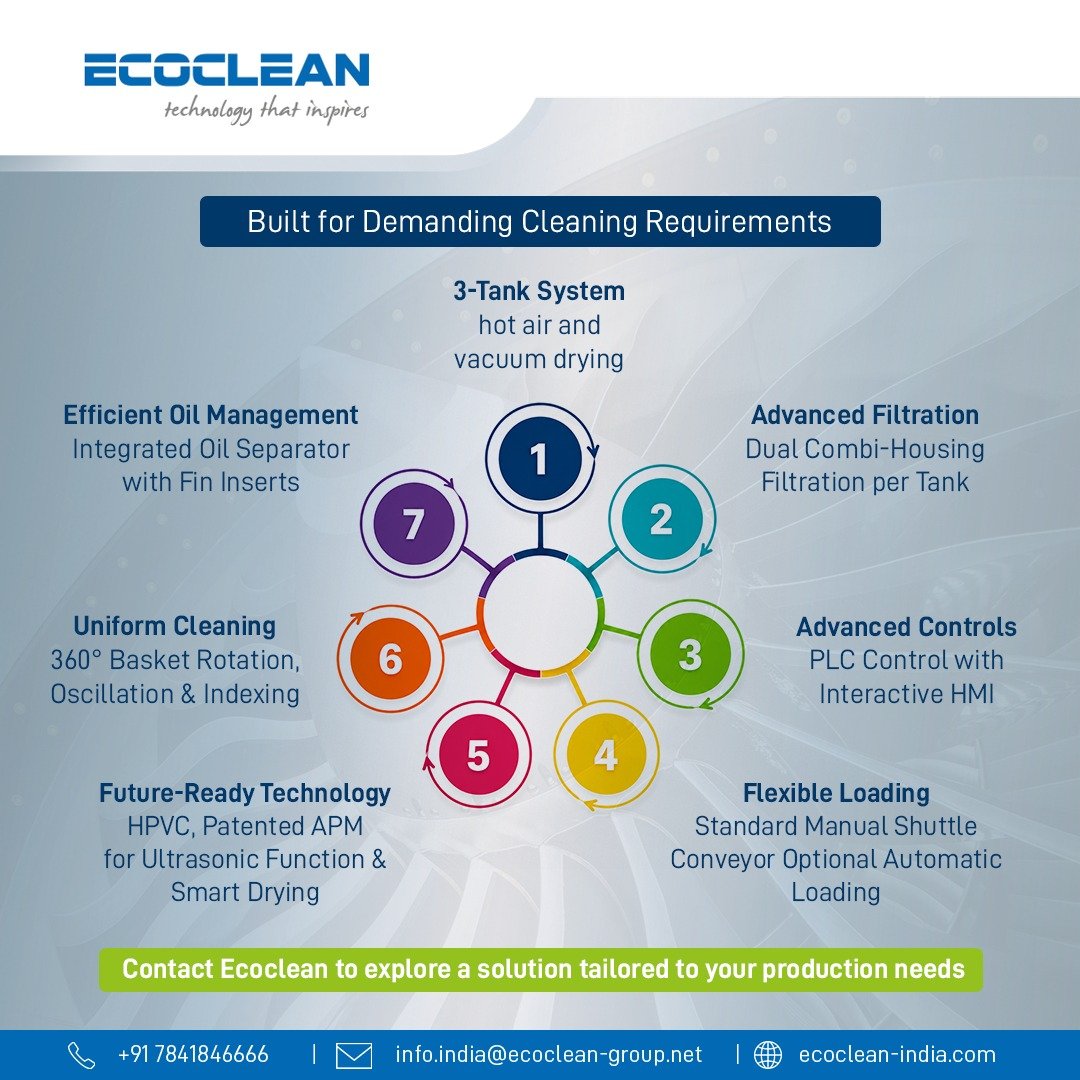
- 3-Tank System with hot air and vacuum drying: parts move through a staged process rather than a single wash-and-hope cycle, finishing with a drying stage that leaves components genuinely dry, not just surface-dry.
- Advanced Filtration with dual Combi-Housing filtration per tank: contamination gets pulled out of the cleaning fluid continuously, so parts aren’t sitting in a bath that’s slowly getting dirtier with every cycle.
- Advanced Controls, PLC control with interactive HMI: process parameters are set, monitored and repeatable, which is what turns a cleaning cycle into something a quality team can actually document and defend during an audit.
- Flexible Loading: standard manual loading or shuttle trolly loading or optional automatic conveyor loading available for higher-throughput production lines.
- Uniform Cleaning through 360° basket rotation, oscillation and indexing: the load itself moves during the cycle, so contamination gets addressed from every angle instead of relying on the fluid alone to reach every surface.
- Future-Ready Technology, HPVC and patented APM for ultrasonic function and smart drying: the platform is built to support advanced ultrasonic and drying capability rather than needing a separate machine bolted on later.
- Efficient Oil Management with an integrated oil separator and fin inserts: oil gets pulled out of the system as part of the process, which keeps cleaning performance from degrading as production volume increases.
A Multi-Stage Approach to Cleaning
EcoCvertex is designed for multi-stage aqueous cleaning, incorporating washing, rinsing and drying within the cleaning cycle. Its process configuration is intended to provide controlled treatment of components while supporting consistent fluid management and filtration.
For applications requiring higher levels of cleanliness, the separation of cleaning and rinsing stages is particularly important. The cleaning stage focuses on removing manufacturing contamination, while subsequent rinsing stages help remove residues associated with the cleaning process before drying.
The system also incorporates advanced fluid management and filtration to support consistent process conditions.
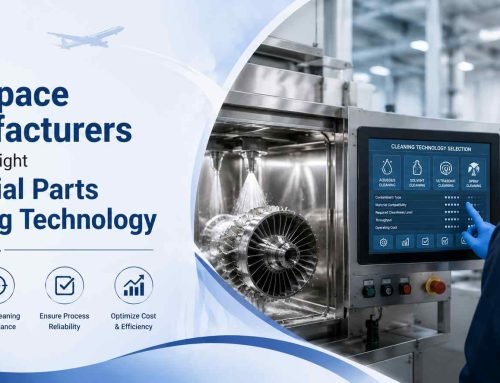
Where Can Aqueous Cleaning Fit in Aerospace Manufacturing?
The suitability of aqueous cleaning depends on the specific application rather than the industry label alone.
Factors to evaluate include:
- Type and level of contamination
- Component material and surface condition
- Component geometry
- Required cleanliness level
- Production volume
- Drying requirements
- Compatibility with subsequent processes
For aerospace components carrying machining oils, coolant residues and particulate contamination, an aqueous process may be appropriate where the component and required cleanliness specification are compatible with the selected cleaning chemistry and process parameters.
EcoCvertex demonstrates how aqueous cleaning can be developed beyond a conventional wash process through multi-stage cleaning, controlled fluid management, filtration and drying. For aerospace manufacturers evaluating water-based cleaning, the starting point should therefore be the application and the required cleaning result not the cleaning medium alone.
Our EcoCvertex product page has the full technical specifications, and our aerospace applications page covers how we’ve approached cleaning across other component types in this sector.
Looking for the right cleaning solution for your application? Connect with Ecoclean to explore the possibilities.
📞 Call: +91-7841846666
📧 Email: info.india@ecoclean-group.net
🌐 Visit: ecoclean-india.com
Contact Ecoclean to Explore a Solution Tailored to Your Production Needs →
Frequently Asked Questions
- Can aqueous-based cleaning really match solvent cleaning for aerospace components?
A. Yes, when the system is engineered with the right process controls. The EcoCvertex pairs aqueous cleaning with a 3-tank staged process, continuous dual filtration and PLC-controlled repeatability, which is what closes the gap that basic aqueous tanks tend to leave against solvent-based systems. - What does the 3-tank system with hot air and vacuum drying actually achieve?
A. It separates the cleaning process into distinct stages rather than relying on one wash cycle, and finishes with a drying stage that removes moisture thoroughly, including from recessed features, so parts leave the machine genuinely dry rather than just surface-dry. - How does the machine prevent contamination from building up in the cleaning fluid over time?
A. Through dual Combi-Housing filtration on each tank and an integrated oil separator with fin inserts, both of which continuously pull contamination and oil out of the system rather than letting it recirculate back onto parts. - Is the EcoCvertex suitable for high-volume production lines?
A. Yes. It supports standard manual shuttle loading as well as an optional automatic conveyor for higher-throughput operations, and its PLC control system is built to keep results consistent regardless of production volume. - How is cleanliness verified on parts cleaned with the EcoCvertex?
A. Through Millipore particle-count testing carried out at our Pune Technology Centre, verified against standards such as ISO 16232 and VDA 19, so results are confirmed before the machine is deployed on your production floor.
Ecoclean India is part of the SBS Ecoclean Group, manufacturing precision parts cleaning systems from our Pune facility since 2008, with in-house testing and validation against ISO 16232 and VDA 19 standards.