

Summary
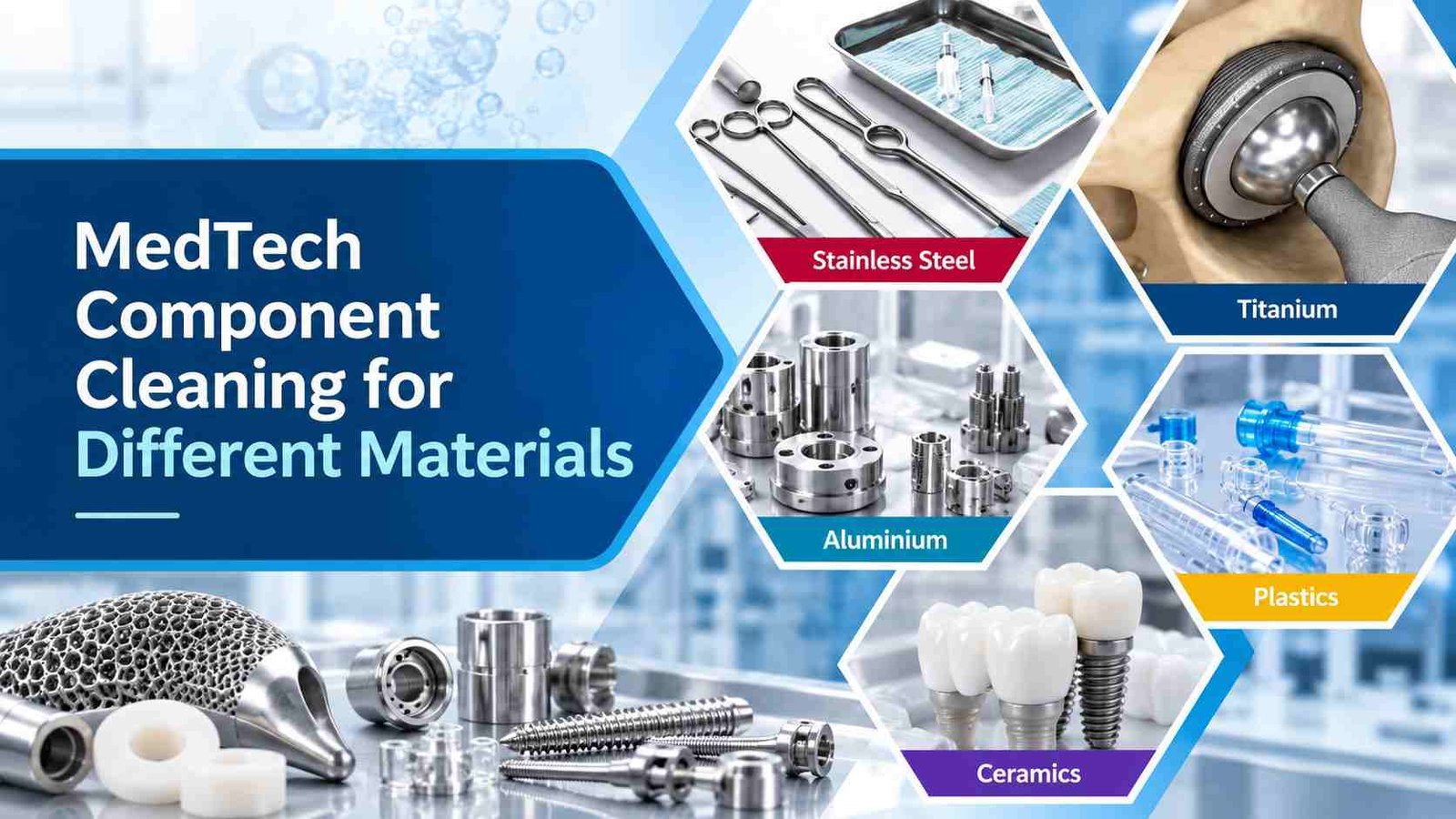
Medical technology components are manufactured from a wide range of materials, including stainless steel, titanium, aluminium, plastics and ceramics. Each material has its own surface characteristics and manufacturing requirements, making it important to select a cleaning process that suits the component and its intended application. Understanding the relationship between material properties, contamination and cleaning technology helps manufacturers establish a suitable process for precision medical components.
Introduction
In medical technology manufacturing, component cleanliness is an important part of production quality. Surgical instruments, medical device housings, implant components and precision parts can undergo several manufacturing operations before they are ready for the next production stage. Machining, grinding, forming, polishing and handling can leave behind oils, particles and other residues that need to be evaluated and removed according to the component’s requirements.
However, a cleaning process suitable for one component may not be appropriate for another. Differences in material composition, surface finish, geometry and sensitivity to cleaning agents can influence how a component should be cleaned.
MedTech component cleaning therefore requires more than choosing a machine based on production volume alone. Manufacturers must understand the material being processed, the type of contamination present and the cleanliness requirements that apply to the finished component.
Ecoclean India provides industrial parts cleaning technologies for different materials and manufacturing applications. Its approach includes evaluating the cleaning task and where appropriate, conducting component cleaning trials to help determine a suitable process.
Table of Contents
- Why material-specific cleaning matters in MedTech
- Cleaning considerations for five common component materials
- Factors that influence the cleaning process
- Selecting suitable cleaning technology
- The importance of cleaning trials and verification
- How Ecoclean India supports MedTech manufacturers
- Frequently asked questions
1. Why Material-Specific Cleaning Matters in MedTech
Medical device components must meet the cleanliness requirements defined for their particular manufacturing process and intended application. Contamination remaining after machining or finishing may interfere with subsequent operations, including assembly, coating, bonding or other surface treatments.
Material selection adds another consideration. Metals, polymers and ceramics do not necessarily respond in the same way to cleaning agents, temperature, mechanical action or drying conditions. A process that is suitable for a robust metal component may require adjustment when applied to a delicate plastic part or a component with a sensitive surface finish.
Component geometry is equally important. Threads, narrow passages, recesses, blind holes and complex internal features can make contamination more difficult to remove. The cleaning process must provide suitable access to these areas without damaging the component.
For this reason, material-specific cleaning should be assessed alongside contamination type, component design and the cleanliness criteria established by the manufacturer.
2. Cleaning Considerations for Five Common MedTech Materials
2.1. Stainless Steel
Stainless steel is used in many medical instruments, equipment components and precision-engineered parts. Its mechanical properties and corrosion resistance make it suitable for numerous demanding manufacturing applications.
During machining and finishing, stainless steel components may accumulate cutting oils, coolants, fine metal particles and polishing residues. These contaminants can remain on surfaces or collect around threaded features and other complex geometries.
An appropriate cleaning process should address the contamination without compromising the component’s surface condition. The selection of cleaning agents, process parameters and drying conditions should take account of the stainless steel grade, surface finish and subsequent manufacturing steps.
Manufacturers should also consider how components are handled after cleaning, since contact with contaminated fixtures, baskets or work surfaces can affect the cleanliness achieved.
2.2. Titanium
Titanium is widely associated with medical implant applications and other precision components where its material properties are important. Cleaning titanium parts requires attention to both the contamination present and the component’s surface condition.
Machining residues, oils and fine particles may remain after manufacturing operations. Components with threads, recessed features or complex shapes can require a cleaning process that reaches these areas effectively.
The cleaning approach should be selected according to the titanium grade, component design, surface treatment and downstream requirements. Cleaning agent compatibility and process conditions should be assessed rather than assuming that a process developed for another metal will produce the same result.
Where surface condition is critical, trials using representative components can help determine whether the proposed cleaning process is suitable.
2.3. Aluminium
Aluminium is used in various medical equipment components, housings and precision-engineered parts. Its relatively lightweight construction makes it useful in applications where component mass and design are important considerations.
However, aluminium surfaces require appropriate process selection. Cleaning agents, temperature and exposure conditions can influence the material’s surface, depending on the alloy and any surface treatment applied.
Manufacturing contamination may include machining oils, emulsions, particles and residues from finishing operations. The cleaning process must address these contaminants while remaining compatible with the component and its intended use.
Before selecting a cleaning system, manufacturers should evaluate the aluminium alloy, surface finish, contamination type and any requirements for subsequent coating, assembly or treatment.
2.4. Plastics
Plastic components are found in medical device housings, connectors, fluid-handling assemblies and other applications. Different polymers can have substantially different chemical and thermal properties, so cleaning requirements should be assessed for the specific material.
Contamination may include processing oils, handling residues, particles and deposits from upstream manufacturing operations. The cleaning process must remove the relevant contamination without causing undesirable changes to the plastic surface or component dimensions.
Compatibility testing is particularly important when choosing cleaning agents and process temperatures. Manufacturers should also consider drying requirements and the possibility of contamination being introduced during handling or packaging.
For sensitive plastic components, cleaning trials can help establish appropriate process conditions before implementation in production.
2.5. Ceramics
Ceramic materials are used in selected precision medical and technical applications. Their surface properties, component geometry and manufacturing methods can influence the cleaning requirements.
Residues from grinding, machining, polishing or handling may remain on ceramic components. Fine particles can collect around holes, recesses and other features, making effective contamination removal an important process consideration.
Cleaning conditions should be evaluated against the particular ceramic material, surface finish and component design. Fragile geometries and tight dimensional tolerances may also influence the acceptable level of mechanical action.
As with other materials, the most suitable cleaning process should be determined by assessing the actual contamination and verifying the results against defined requirements.
3. Factors That Influence the Cleaning Process
Material is only one part of the cleaning decision. A suitable process must also account for the manufacturing conditions and the expected cleanliness outcome.
Type of contamination
The first consideration is identifying what needs to be removed. Machining oils, emulsions, fine particles and polishing residues can behave differently during cleaning. Understanding the contamination helps narrow down the cleaning technology and process conditions that should be evaluated.
Component geometry
Surface accessibility affects cleaning performance. Threads, cavities, narrow channels and blind holes may require specific arrangements for cleaning fluid access, rinsing and drying. Component orientation and loading arrangements can also influence the result.
Surface condition and material compatibility
Cleaning agents and process parameters must be compatible with the component material and its surface treatment. This is particularly relevant when working with plastics, treated aluminium, polished surfaces and precision components.
Required cleanliness
Manufacturers should establish the cleanliness criteria that apply to the component and the next manufacturing stage. These requirements may include limits for residual particles or other contamination, depending on the application and customer specifications.
Production and drying requirements
Batch size, throughput, cycle time, loading method and available installation space all influence system selection. Drying must also be considered where residual moisture could affect subsequent assembly, packaging or processing.
4. Selecting Suitable Cleaning Technology
Different cleaning technologies offer different process capabilities. Their suitability depends on the material, contamination, geometry and production requirements of the application.
Aqueous cleaning
Aqueous cleaning uses water-based cleaning agents and can be suitable for applications involving coolants, emulsions, certain oils and particulate contamination. Depending on the system configuration, processes may combine spray cleaning, immersion, rinsing and drying.
Ecoclean India’s portfolio includes aqueous systems such as the Universal 81W, EcoCmini, EcoCtwin and EcoCvertex. The appropriate configuration depends on the component and the required cleaning task.
Solvent-based cleaning
Solvent-based cleaning can be considered for applications involving oil-based contamination and components with complex geometries. Depending on the system and cleaning medium, multi-stage processes can combine cleaning, rinsing and drying.
Ecoclean India’s portfolio includes solvent-based systems such as the Universal 81C and Minio 85C. The suitability of a solvent-based process should be evaluated against material compatibility, contamination and applicable operating requirements.
Ultrasonic cleaning
Ultrasonic cleaning can support the removal of contamination from intricate component features. Its effectiveness depends on factors such as the component geometry, cleaning medium, contamination, process configuration and material compatibility.
For applications requiring precision cleaning, ultrasonic technology may form part of a process designed around the specific component and cleanliness target.
No single cleaning technology should be assumed to be suitable for every MedTech material. Process selection should be based on the actual cleaning task and verified results.
5. The Importance of Cleaning Trials and Verification
A cleaning process should be evaluated using representative components and relevant manufacturing contamination wherever practical. This helps establish whether the selected technology and process conditions are appropriate before the system is introduced into production.
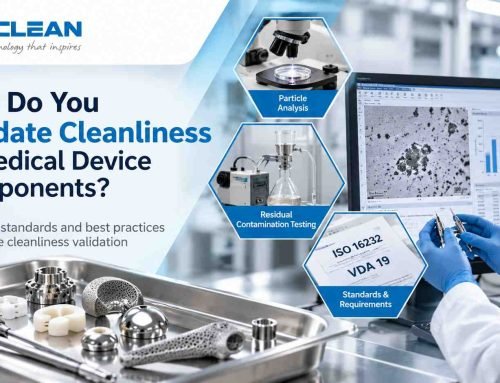
Ecoclean India operates a Technology Centre in Pune where manufacturers can conduct cleaning trials using their own components. Available evaluation activities include Millipore testing for residual contamination and particle analysis against applicable cleanliness requirements, including ISO 16232 and VDA 19 where relevant to the application.
These methods can help assess residual contamination, but the appropriate test and acceptance criteria depend on the component, customer requirements and applicable standards. Results should be interpreted against predefined specifications rather than treated as a universal measure of medical device cleanliness.
Cleaning trials also provide an opportunity to evaluate process repeatability, drying requirements, component handling and the suitability of different cleaning approaches.
6. How Ecoclean India Supports MedTech Manufacturers
Ecoclean India, part of the SBS Ecoclean Group, develops and supplies industrial parts cleaning technologies for a range of manufacturing applications. Its portfolio includes aqueous, solvent-based and ultrasonic cleaning systems for components made from metals, plastics, ceramics and other materials.
The company’s Pune Technology Centre enables manufacturers to evaluate cleaning processes using their own components. This application-focused approach helps connect component requirements with appropriate cleaning technology and process conditions.
For MedTech manufacturers, the key objective is to establish a cleaning process that is compatible with the material, removes the relevant contamination and meets the defined requirements for the next manufacturing stage.
Learn more about Ecoclean India’s industrial cleaning systems and solutions or explore its technical cleanliness solutions.
Conclusion
Material selection is an important consideration when developing a cleaning process for medical technology components. Stainless steel, titanium, aluminium, plastics and ceramics each present different compatibility, surface and geometry considerations that should be assessed before selecting cleaning equipment.
By identifying the contamination, defining the required cleanliness level and evaluating suitable cleaning technologies, manufacturers can develop a process that fits their component and production requirements. Cleaning trials and appropriate verification methods provide additional information to support process selection.
Ecoclean India’s cleaning technologies and Pune Technology Centre offer manufacturers a way to evaluate application-specific cleaning requirements before deciding on an industrial parts cleaning system.
7. Frequently Asked Questions
1. Why is material compatibility important in MedTech component cleaning?
A. Different materials can respond differently to cleaning agents, temperature and mechanical action. Evaluating compatibility helps reduce the risk of surface damage or unwanted changes while addressing the contamination present.
2. Which materials can be cleaned using industrial parts cleaning systems?
A. Industrial cleaning systems can be used for a variety of materials, including stainless steel, titanium, aluminium, plastics and ceramics. The appropriate technology and process conditions depend on the material, component geometry, contamination and cleanliness requirements.
3. Is aqueous cleaning suitable for medical device components?
A. Aqueous cleaning can be suitable for certain medical device components, particularly where the contamination and material are compatible with the cleaning medium. The process should be evaluated for the specific component, including rinsing and drying requirements.
4. How can manufacturers verify the cleanliness of MedTech components?
A. Verification methods depend on the component and its specified requirements. Depending on the application, evaluation may include residual contamination testing, particle analysis and other customer-defined checks. Acceptance criteria should be established before testing.
5. Can Ecoclean India conduct cleaning trials for MedTech components?
A. Ecoclean India offers cleaning trials at its Technology Centre in Pune. Manufacturers can discuss their component material, contamination and process requirements to evaluate a suitable cleaning approach.
Discuss Your MedTech Cleaning Requirements
Selecting a cleaning process starts with understanding the component, its material and the contamination that must be removed. Ecoclean India’s team can discuss your application and the available options for evaluating a suitable cleaning process.
Contact Ecoclean India
Phone: +91-9028261666
Email: info.india@ecoclean-group.net
Website: https://ecoclean-india.com/