

MedTech parts cleaning machines: Minio 85C, Universal 81C/P, EcoCvertex and UCMCombiLine
MedTech components undergo several manufacturing and finishing operations before they are ready for assembly, sterilisation or packaging. CNC machining, grinding, polishing and other processes introduce different types of contamination, from machining oils and coolants to abrasive particles, polishing pastes and fine residues.
Each operation creates its own cleaning requirements. The cleaning process must therefore be designed around the type of contamination, component geometry, material compatibility and required cleanliness level.
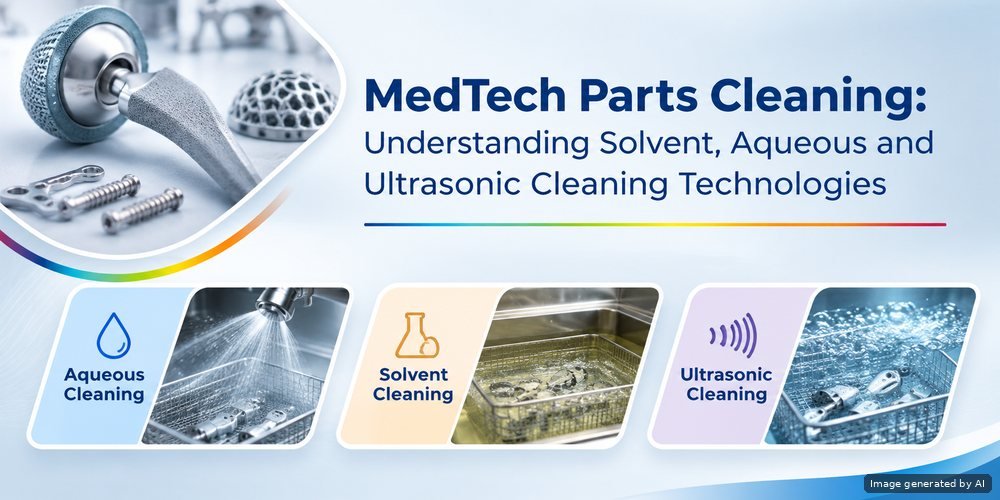
Ecoclean offers a range of industrial parts cleaning technologies for medical component manufacturing, including solvent-based, aqueous-based and ultrasonic cleaning systems. These technologies address different cleaning challenges and can be configured according to the specific application.
Among Ecoclean India’s solutions are the Minio 85C, Universal 81C/P, EcoCvertex and UCMCombiLine.
Different Manufacturing Stages, Different Cleaning Requirements
The nature of contamination changes throughout medical component manufacturing. After CNC machining, components may carry cutting oils, coolants, greases, metal chips and machining particles. Grinding and polishing can introduce abrasive particles, polishing pastes and fine residues. Surface treatment and finishing operations may leave chemical residues that require removal before the next process.
The requirements can become more demanding as components move towards final cleaning, assembly and packaging. At this stage, the focus is not only on removing visible contamination but also on achieving the specified level of technical cleanliness and preventing recontamination.
A cleaning process that effectively removes machining oils may not be sufficient for fine polishing particles or other residues. This is why cleaning technology and process configuration must be selected according to the complete application rather than relying on a standard approach.
- After CNC machining: Components may carry cutting oils, coolants, greases, metal chips and machining particles. The cleaning process needs to address both filmic and particulate contamination.
- After grinding and polishing: Abrasive particles, grinding dust and polishing pastes become the primary cleaning challenges. Fine particles can remain on surfaces and in complex component geometries.
- Final cleaning and passivation: The focus shifts towards achieving the specified final cleanliness level and preventing recontamination before the next operation
Ecoclean Technologies for MedTech Component Cleaning
Ecoclean’s portfolio includes different machine concepts and configurations to address a wide range of cleaning requirements.
| Machine | Technology | Key capabilities |
| Minio 85C | Solvent-based | Compact solvent cleaning system with vapour degreasing and vacuum drying options. |
| Universal 81C/P | Solvent-based | Multi-operational single-chamber cleaning. The 81C uses non-halogenated hydrocarbons, while the 81P is designed for polar and partially polar solvents. |
| EcoCvertex | Aqueous-based | Multi-stage aqueous cleaning with washing, rinsing, filtration and drying capabilities, including a dedicated fine-cleaning stage. |
| UCMCombiLine | Ultrasonic Cleaning | Modular system with self-sufficient stations, dual-frequency technology and tank capacities from 50 to 220 litres. |
Beyond these, Ecoclean offers a wider range of standard and customised cleaning systems. Machine configuration, process stages and cleaning parameters can be adapted to the specific component and cleanliness requirements.
Minio 85C
The Minio 85C is the solvent washer for minimal space. It uses non-halogenated hydrocarbons under vacuum, with vacuum distillation to keep the solvent clean and double filtration when the chamber fills and empties. The baskets rotate and swivel to help both cleaning and drying. An ultrasonic unit is available as an option. It is a sensible fit for small and mid-sized MedTech shops that need solvent cleaning without giving up floor space. We cover its use in precision work in our post on compact solvent-based cleaning for aerospace components.
Universal 81C/P
The Universal 81C is the universal solvent-based solution in the range, made for the Indian market. Like the Minio 85C, it is built in Pune, which keeps delivery and spare parts close. Read how it performs on demanding parts in Universal 81C/P solvent-based cleaning for aerospace components.
EcoCvertex
The EcoCvertex is an aqueous-based system with an upright cylindrical third tank for fine cleaning. If your parts carry water-soluble residue, or your validation plan prefers aqueous media, this is the machine to look at. Our blog on aqueous-based cleaning for aerospace manufacturing shows how it is applied.
UCMCombiLine
The UCMCombiLine is a semi-automatic, modular ultrasonic system for small parts, available from 50 to 220 litres with selectable dual frequencies. Ultrasonic immersion is where most final and fine cleaning of MedTech parts is done, so this machine often sits at the end of the cleaning route.
Cleanliness Evaluation for MedTech Components
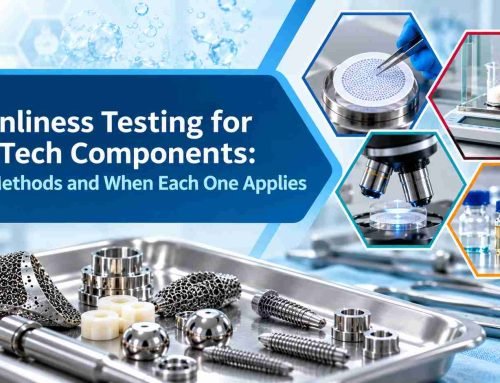
For medical components, evaluating cleanliness involves more than checking for visible or particulate residues. Depending on the component, application and intended use, different evaluation methods may be required to understand the nature of residual contamination.
Key evaluation methods include:
- TOC (Total Organic Carbon): Quantifies organic residues remaining on components or in the relevant test extracts.
- Bioburden testing: Determines the level of microbial contamination, particularly important before sterilisation.
- Cytotoxicity testing: Evaluates whether residual substances may cause harmful effects on living cells, supporting the assessment of biological safety.
- Particle analysis: Provides complementary information about particulate contamination, including particle characteristics where required.
The selection of evaluation methods depends on the medical component, its intended application and the relevant cleanliness and biological safety requirements.
The Right Cleaning Process Starts with the Application
There is no single cleaning technology suitable for every medical component or manufacturing process. The choice depends on contamination characteristics, component geometry, material compatibility, production requirements and the specified cleanliness level.
With its range of solvent-based, aqueous-based and ultrasonic cleaning systems, Ecoclean supports medical component manufacturers in developing cleaning processes suited to their individual applications.
Book a Cleaning Trial for Your Components →
Not sure which machine suits your MedTech component? Speak to the Ecoclean India team.
📞 Call: +91 784 184 6666
📧 Email: info.india@ecoclean-group.net
🌐 Visit: ecoclean-india.com
Explore Our Machines for Precision Cleaning →
Frequently Asked Questions
Q. 1. Which machine is best for removing oil after CNC machining of MedTech parts?
A. Solvent systems such as the Minio 85C and Universal 81C/P are designed for oils, greases and swarf. The right choice still depends on part size, material and your cleanliness limits, so test your own components before you decide.
Q. 2. When should I choose aqueous cleaning with the EcoCvertex instead of solvent?
A. Choose aqueous when the contamination is water-soluble, or when your process or validation plan calls for water-based media. Oily residue from machining often suits solvent better. A trial on your parts will show which gives the cleaner result.
Q. 3. Are these machines made in India?
A. Ecoclean India features the Minio 85C, Universal 81C/P, EcoCvertex and UCMCombiLine as Made in India machines. The Minio 85C and Universal 81C/P are produced at the Pune facility, which keeps delivery times and spare parts support short.
Q. 4. Do I need ultrasonic cleaning for MedTech parts?
A. For final and fine cleaning of small, complex parts, ultrasonic immersion is the usual choice. The UCMCombiLine is the ultrasonic machine in this group, and an ultrasonic unit is also available as an option on the Minio 85C.
Q. 5. Can I test my parts before buying a machine?
A. Yes. Ecoclean India’s Technology Centre in Pune lets manufacturers run cleaning trials and Millipore tests on their own components before making a purchase decision.