

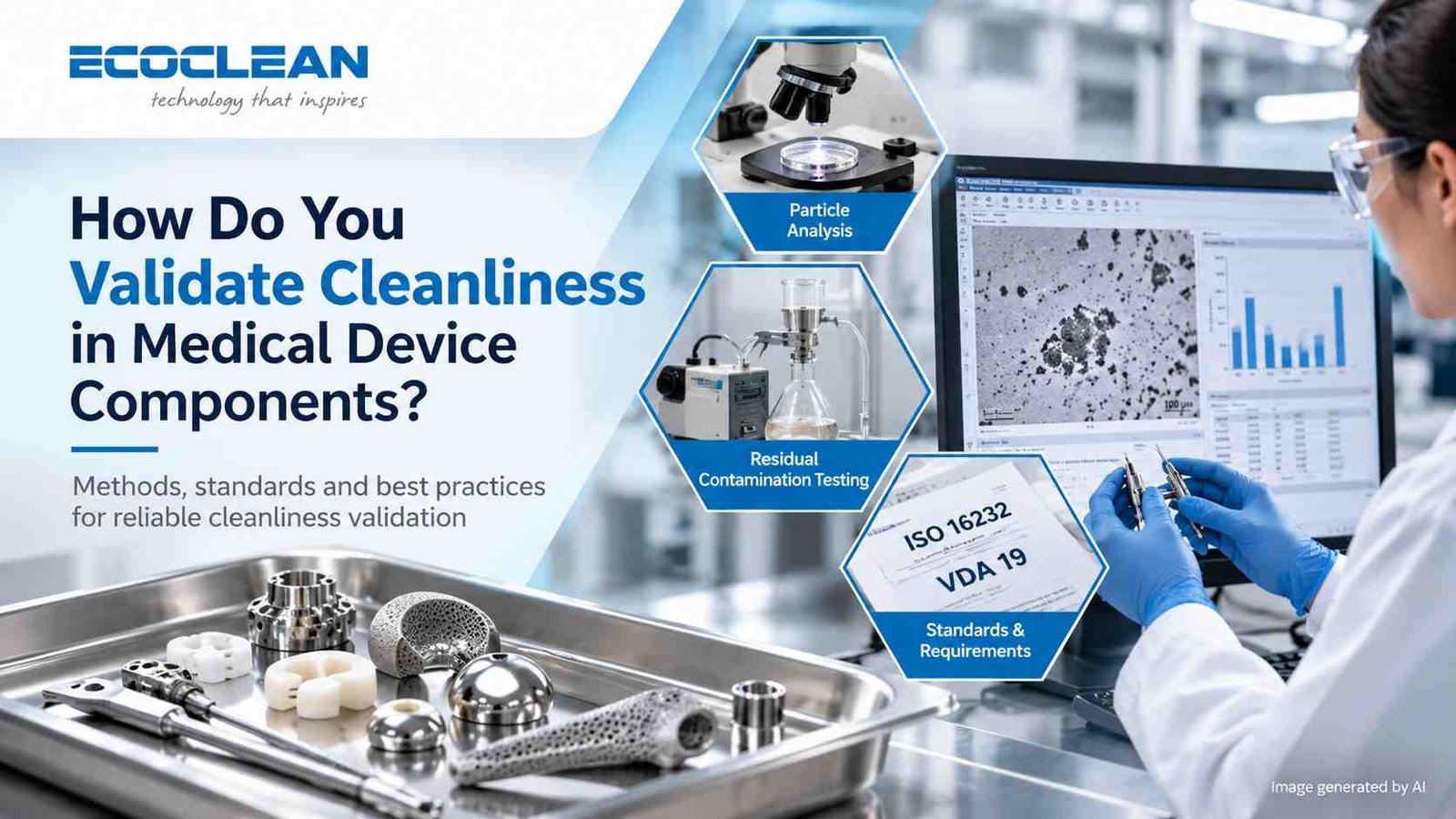
A component can look spotless and still fail a cleanliness check. Anyone who has spent time around machined implants, surgical instruments or cannulas knows this. Machining oil sits in a blind hole. A trace of polishing compound hides in a thread. The part passes the eye test, then the lab report says otherwise.
That is why cleaning validation for medical device components matters. Cleaning a part is one step. Proving, with measurable and documented results, that the process removes the contaminants that matter for the intended use is another. This guide walks through how that proof is built, in the order most manufacturers work through it.
1. Define What Cleanliness Means for Your Component
Before choosing a cleaning technology or a test method, decide what you are actually trying to remove, and how clean is clean enough.
The answer depends on the material, the manufacturing operations, the intended use and what happens to the part afterwards. Depending on the application, the assessment may cover:
- Particulate contamination
- Organic residues, including machining oils and lubricants
- Residual cleaning agents and other chemical contaminants
- Microbiological contamination
- Bacterial endotoxins, where applicable
- Biological safety concerns linked to residual contaminants
Not every component needs every test. The strategy should follow the identified risks and the product requirements, not a generic checklist.
2. Choose the Right Method for Each Contaminant
A method that measures one kind of residue cannot prove the absence of another. This is the point most teams learn the hard way.
- Total Organic Carbon (TOC): TOC measures the organic carbon in a sample and helps assess organic residues, provided the extraction procedure, analytical method and acceptance criteria suit the contaminants being investigated. It is useful for residues from machining or cleaning. It does not identify individual compounds, and it says nothing about particles or microorganisms.
- Bioburden testing: This determines the population of viable microorganisms on a product or component under a defined method. It becomes relevant when microbial contamination has to be controlled before sterilisation. The right approach depends on the device and the applicable microbiological requirements.
- Particle analysis: Where loose particles could affect safety, function or suitability, they need to be assessed. Particle size, quantity and morphology can all matter. The method should match the cleanliness specification, the component geometry and the extraction procedure. Gravimetric and Millipore filter-based testing are commonly used here, depending on the specification.
- Cytotoxicity and biological evaluation: Removing manufacturing residues is important, but so is understanding their possible biological effect. Cytotoxicity testing looks at whether a material or its extract can harm cells under defined conditions. It sits within biological evaluation where required. It is not a direct measure of cleanliness, and it is not a universal test for every cleaned part. Whether it applies depends on the device, its materials, its intended use and the risk assessment.
3. Work to the Standards That Apply to Your Device
Validation should be built around the requirements of your specific device and process.
Two references come up often:
- ISO 19227:2018 covers cleanliness requirements and cleaning process validation for orthopaedic implants, including a risk-based evaluation of contaminants.
- ASTM F3127:2022 gives guidance on validating cleaning processes used during the manufacture of medical devices, including analytical methods, sampling, acceptance limits, procedures and documentation.
Their scopes are different. ISO 19227 is specific to orthopaedic implants. ASTM F3127 addresses critical cleaning processes during initial fabrication and assembly, before first use and it does not primarily cover cleaning validation for reusable devices. Pick the standard that fits the device and its application, rather than applying one across every MedTech product.
4. Qualify the Equipment, Then Validate the Process
Getting a part clean once during a trial proves very little. The system has to deliver the same result, run after run, under defined conditions.
Equipment qualification usually includes:
- Design Qualification (DQ), where applicable
- Installation Qualification (IQ)
- Operational Qualification (OQ)
- Performance Qualification (PQ), as the validation plan requires
Process validation then shows that the defined process consistently meets the acceptance criteria. The parameters that normally need control include cleaning time, temperature, cleaning medium, ultrasonic energy where used, rinsing conditions, drying and filtration.
Geometry deserves special attention. Blind holes, narrow passages, capillaries and complex internal surfaces are where cleaning gets difficult and where ultrasonic cleaning systems and process design have to be matched to the part.
5. Validate Under Representative Production Conditions
A cleaning process has to be tested on real components or representative test specimens, under conditions that reflect actual production. Lab results on clean, simple coupons rarely tell the full story.
Factors worth considering:
- Component material and geometry
- Type and quantity of manufacturing residues
- Surface condition
- Accessibility of internal features
- Cleaning, rinsing and drying requirements
- Repeatability of results
This is where cleaning trials are valuable. At our Pune Technology Centre, manufacturers can evaluate cleaning technologies and develop suitable process parameters for their own components before committing to a production setup. It gives you a practical basis for decisions, instead of assumptions.
6. Control Contamination During Testing and Handling
A result is only as reliable as the way the sample was collected, handled and analysed. When contamination limits are low, even a small amount picked up during handling can change the outcome and send you chasing a problem that came from the test, not the process.
A controlled approach typically includes:
- Proper handling and protection of cleaned components
- Suitable laboratory conditions
- Trained personnel
- Validated or appropriately qualified analytical methods
- Control samples or blanks, where applicable
- Suitable extraction media and test equipment
- Sample identification and traceability
- Defined procedures for packaging and preserving samples
These controls make sure the report reflects the condition of the component, not of the testing environment. Our technical cleanliness testing work is set up with this principle in mind.
Cleanliness Has to Be Demonstrated, Not Assumed
For medical device manufacturers, cleanliness is not a visual outcome. It is a defined requirement, measured with suitable methods and backed by records.
TOC, bioburden, particle analysis and biological evaluation each answer a different question. Choosing the right combination takes a clear understanding of the component, how it is made and where it will be used. Add equipment qualification, process validation and controlled testing, and you get a cleaning process that can meet its specification consistently.
If you are planning a new cleaning process or revalidating an existing one, our team can help you start with the right trials and the right questions.
Book a Cleaning Trial at Pune Technology Centre →
Frequently Asked Questions
- What is cleaning validation in medical device manufacturing?
A. It is the documented process of showing that a cleaning process consistently removes the contaminants that matter for a device, to defined acceptance limits. It combines process parameters, analytical testing and records, so the result can be repeated and shown to an auditor. - Is visual inspection enough to confirm a component is clean?
A. No. Oils, chemical residues, fine particles and microorganisms can remain on a surface that looks clean. Visual checks can be part of the routine, but measurable methods are needed to demonstrate cleanliness. - Which test should I use: TOC, bioburden or particle analysis?
A. It depends on the contaminant you need to control. TOC addresses organic residues, bioburden addresses viable microorganisms and particle analysis addresses particulate contamination. Most components need a combination chosen through risk assessment, not a single test. - Do ISO 19227 and ASTM F3127 apply to every medical device?
A. No. ISO 19227 is specific to orthopaedic implants. ASTM F3127 covers critical cleaning processes during initial manufacture and assembly of medical devices, and it does not primarily address reusable device validation. Select the standard that matches your device and use. - Why are cleaning trials important before validation?
A. Trials on actual components, under realistic conditions, help you set cleaning time, temperature, medium, rinsing and drying parameters before you validate. They show how the process handles your geometry and your residues, which reduces surprises later.