


Summary
Technical cleanliness is a critical quality requirement in modern automotive and aerospace manufacturing. Even microscopic particles left on machined components can affect assembly accuracy, lubrication performance and long-term system reliability.
To manage contamination risks, manufacturers use standardized methods to evaluate particulate contamination on components. Standards such as ISO 16232 and VDA 19 provide structured procedures for extracting, filtering and analyzing particles removed from component surfaces.
When supported by process-controlled industrial cleaning systems, these standards help manufacturers maintain consistent cleanliness levels in production.
What Technical Cleanliness Means
Technical cleanliness refers to the controlled measurement and management of particulate contamination present on component surfaces.
In precision assemblies, even very small particles may cause functional issues in systems such as:
- fuel injection systems
- hydraulic systems
- transmission assemblies
- aerospace actuators and valves
- turbine components
Maintaining defined cleanliness levels is therefore essential for ensuring reliable system performance.
Cleanliness Standards Used in Automotive Manufacturing
Automotive manufacturers commonly use the following standards to evaluate component cleanliness:
- ISO 16232
- VDA 19
- These standards define procedures for:
- selecting cleanliness testing methods
- validating extraction procedures
- filtering and analyzing particles
- documenting contamination levels
It is important to note that these standards describe measurement methodology rather than cleanliness limits. Cleanliness limits are typically defined by OEMs or Tier-1 suppliers based on component function.
Aerospace Cleanliness Standards
In aerospace manufacturing, additional cleanliness standards may apply depending on the application. And they are defined by the manufacturers as per their need. These custom standards are used to evaluate contamination levels in hydraulic systems, fuel systems and clean manufacturing environments used in aerospace production.
The Technical Cleanliness Inspection Process
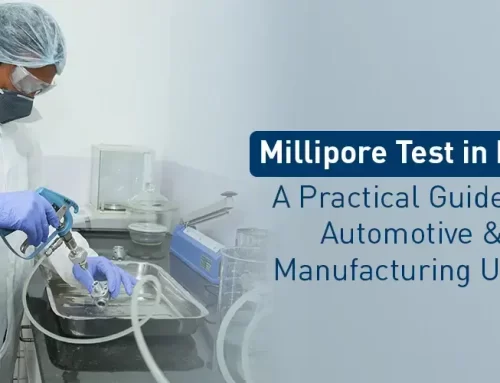
Technical cleanliness inspection typically involves three main steps.
-
Particle Extraction
Contaminants are removed from component surfaces using techniques such as pressure rinsing, ultrasonic extraction or agitation.
-
Particle Filtration
The extraction liquid is filtered through a defined membrane that captures the particles removed from the component.
-
Particle Analysis
Particles collected on the filter are analyzed using gravimetric or optical methods to determine particle size, quantity and weight.
This structured evaluation process enables manufacturers to measure contamination levels consistently.
Role of Cleaning Systems in Achieving Cleanliness Requirements
While cleanliness standards define how contamination is measured, achieving the required cleanliness levels depends on the effectiveness of the cleaning process.
Modern industrial parts cleaning systems operate under controlled process parameters including:
- spray pressure and flow distribution
- cleaning media filtration
- process temperature control
- integrated drying technology
These controlled conditions help manufacturers consistently achieve defined cleanliness specifications in both automotive and aerospace production environments.
Conclusion
When contamination is dominated by oils, greases and machining fluids, solvent-based cleaning technology is often the most effective solution.
In the next article, we take you to AeroDef 2026 happening from 8 to 10 April 2026 at New Delhi, where Ecoclean India will showcase its cleaning solutions for aerospace and defence industries, including the UCMCombiLine. Stay tuned for more details.