


Summary
In modern automotive and precision manufacturing, cleanliness is a defined technical requirement — not a visual inspection criterion. Particulate contamination on components directly influences assembly performance, functional reliability, and service life.
The Millipore Test is widely used to quantify residual contamination on components and verify compliance with defined technical cleanliness specifications such as ISO 16232 and VDA 19 in Automotive industry. For manufacturing units in India, it serves as a validation and monitoring tool within a controlled cleaning process.
This guide explains the principle of the Millipore test, its role in production, and how process-controlled cleaning systems support stable and reproducible cleanliness values.
Introduction
As component geometries become more complex and tolerances continue to shrink, particulate contamination has a direct impact on product performance. Even microscopic metallic or non-metallic particles can affect the performance after it’s assembly/
The Millipore test provides a measurable method to evaluate residual particulate contamination and validate cleaning effectiveness.
Why Technical Cleanliness Matters in Manufacturing
Technical cleanliness is particularly critical in:
- Powertrain components
- Fuel injection systems
- Hydraulic assemblies
- Brake systems
- Precision machined assemblies
- Battery trays in EV
- MedTech applications such as implants, surgical instruments
- Precision optics
Uncontrolled contamination may lead to:
- Premature wear
- Functional malfunction
- Reduced service life
- Increased warranty risks
Standards such as ISO 16232 and VDA 19 define procedures for the extraction, filtration, and evaluation of particulate contamination in automotive components.
To consistently meet these requirements, cleaning must be integrated into the manufacturing process not treated as a downstream corrective action.
What Is a Millipore Test?
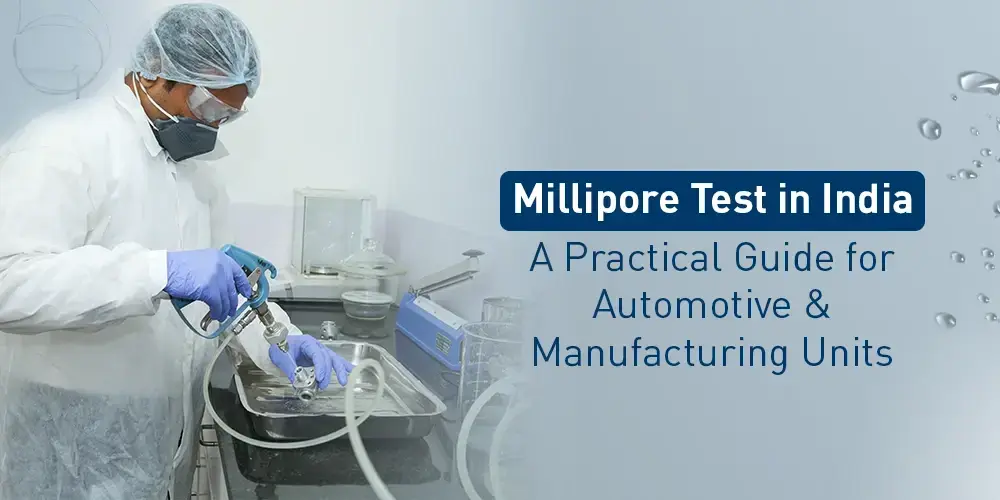
The Millipore test is a laboratory method used to determine the quantity and characteristics of particulate contamination on components.
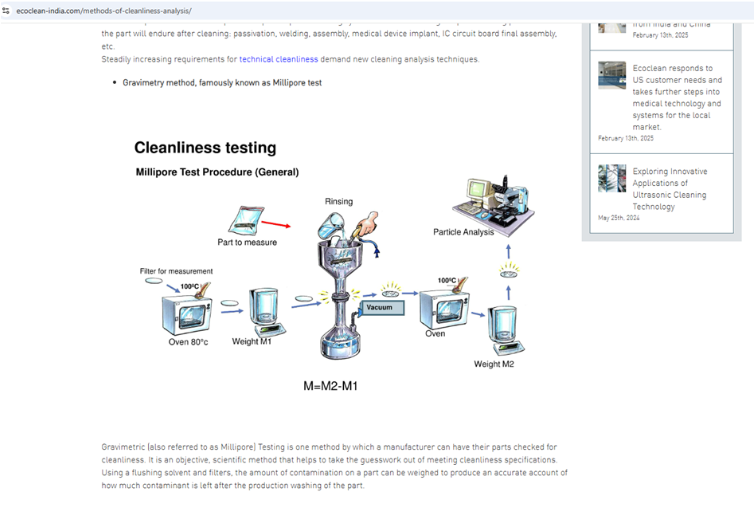
The principle is based on:
- Controlled extraction of particles from the component
- Filtration of the extraction fluid through a defined membrane
- Drying and gravimetric evaluation of the membrane
- Optional microscopic particle size analysis
The result is expressed as a measurable cleanliness value, typically in milligrams of contamination per component or per defined surface area.
This enables objective comparison against customer-specific or standard-defined limits.
How the Millipore Testing Process Works
Reliable Millipore results depend on standardized procedures and controlled laboratory conditions.
The main steps include:
- Defined extraction method (spray, ultrasonic, immersion)
- Membrane filtration under controlled conditions
- Drying in contamination-free environment
- Gravimetric weighing
- Microscopic particle size classification (if required)
Consistency in extraction and handling is essential to avoid secondary contamination or measurement deviation.
Role of Cleaning Machines in Achieving Target Millipore Values
Millipore testing evaluates contamination it does not remove it.
Achieving defined cleanliness levels requires a stable and repeatable cleaning process.
Modern, process-controlled cleaning process manage critical parameters such as:
- Production quality
- Contamination and dirt input
- Selection of cleaning media
- Selection of cleaning technology
- Handling of parts
- Ambient Conditions
- Packaging of cleaned parts
By stabilizing these variables, the cleaning process delivers predictable contamination reduction.
In practice, Millipore testing is typically performed:
- Before cleaning – to identify input contamination
- After cleaning – to verify compliance with specified limits
When cleaning systems operate under controlled conditions, measured Millipore values show stable and reproducible trends, supporting production validation.
Common Contamination Sources in Manufacturing
Understanding contamination origin is essential for defining the appropriate cleaning strategy.
Typical contamination sources include:
- Machining chips and burrs
- Abrasive residues
- Coolants and cutting oils
- Handling debris
- The dirt level of apparatus
- Soft particles including fibers from ambient environment
Process-engineered cleaning systems are designed to remove these contaminants under controlled and validated conditions.
Methods of Measuring Technical Cleanliness
Some of the standard methods of cleanliness testing include:
- Visual Inspection
- Water Break Test
- Surface Tension Test
- Millipore Testing
- Particle Analysis
Integrating Millipore Testing into Cleaning Process
For effective contamination control, effective Millipore testing should be integrated into the industrial parts cleaning process.
Ecoclean offers Millipore Testing and Particle Analysis at our Technology Center in Pune
In addition to cleaning machines, Ecoclean’s Tech Center in Pune offers advanced solutions for cleanliness testing.
- Millipore and Gravimetry Analysis
- Cleanliness Testing setup in advanced cleanroom (ISO 14644-1, Class 8)
- Particle size, count, shape measurement using “MicroQuick Particle Scanner”
- Particle size, count, shape measurement using automatic microscope
Conclusion
The Millipore test provides a structured and measurable approach to verifying technical cleanliness in automotive and precision manufacturing.
However, testing alone does not mean compliance.
Stable and reproducible cleanliness results are achieved only when supported by process-controlled cleaning systems that manage contamination removal under defined conditions.
For manufacturing units in India operating under global supply chain requirements, integrating Millipore testing with engineered cleaning processes ensures:
- Reliable component performance
- Reduced rejection rates
- Controlled production quality
- Compliance with defined cleanliness standards