

In the automotive and precision manufacturing sector, degreasing is not an independent process it is an integral part of the production chain. Residual oils, greases, and processing media must be removed reliably to ensure downstream assembly, coating, heat treatment or testing processes function without disruption.
Selecting the appropriate cleaning technology therefore requires a clear understanding of:
- Component geometry
- Type and level of contamination
- Required cleanliness specification
- Production volume
For manufacturing units in India supplying to global OEMs and Tier suppliers, cleaning systems must deliver consistent, validated and reproducible results under continuous operation.
Industrial Cleaning Technology for Degreasing
Industrial degreasing today is performed using engineered cleaning systems that operate under defined and controlled process conditions.
In high-precision industries solvent-based systems are widely used where:
- Oils and greases are difficult to remove
- Components have complex geometries
- Blind holes and fine structures are present
- Residue-free drying is required
Modern closed-loop solvent cleaning systems operate in closed chamber and typically include:
- Multi-stage cleaning cycles
- Spray Cleaning and Injection Flood Washing
- Ultrasonic cleaning (if required)
- Integrated distillation
- Solvent recovery
- Vacuum drying
These systems are designed to maintain stable process parameters such as temperature, filtration efficiency, and solvent purity, ensuring repeatable cleaning performance.
Application Areas
Industrial solvent-based cleaning systems are typically used for cleaning of parts used in:
- Automotive powertrain components
- Fuel injection systems
- Transmission Assembly
- Precision machined components
- Bearing components
- Aerospace parts
Industries with defined cleanliness standards often referencing guidelines such as VDA 19 and ISO 16232 require controlled cleaning solutions capable of delivering measurable and documented results.
Why Degreasing Is Required in Modern Manufacturing
Residual contamination can lead to:
- Poor coating adhesion
- Assembly failure
- Increased wear
- Functional failure
In precision manufacturing, contamination levels directly affect product performance and service life.
Degreasing is therefore not only about surface appearance. It is about:
- Functional reliability
- Process stability
- Warranty risk reduction
- Compliance with customer specifications
A process-controlled cleaning system ensures contamination removal is stable, validated, and reproducible.
When Solvent-Based Cleaning Technology Is Technically Recommended
Solvent-based cleaning systems are particularly recommended under specific contamination and material conditions where aqueous systems may not deliver reliable results.
Typical technical scenarios include:
-
Oil Dominated Contamination
When input contamination consists primarily of neat cutting oils, Rust Prevention (RP) oils. Solvent media provides high dissolution efficiency for non-polar oil residues, ensuring effective removal without requiring high mechanical energy or aggressive chemistry.
-
Rust Preventive Oils Before Final Assembly
In many automotive and export-oriented manufacturing environments, components are coated with corrosion protection oils before storage or shipment to final assembly plants. Solvent-based systems are well suited for removing these protective oils in a controlled and residue-free manner before assembly.
-
Components with Metal Porosity
Certain materials have micro-porosity within the component surface. Vacuum-based solvent cleaning systems provide effective penetration of media while enabling reliable and 100% drying.
Solvent-Based Cleaning Machines Offered by Ecoclean India
Ecoclean India manufactures advanced solvent-based cleaning systems designed for precision industrial applications.
Two key Made-in-India systems include:
Universal 81C
The Universal 81C is a modular solvent cleaning system, made in India, engineered for medium to high production volumes. It offers:
- Single chamber, multi-stage cleaning capability
- Integrated solvent distillation and recovery
- Fine filtration systems
- Vacuum drying
- Process stability for serial production
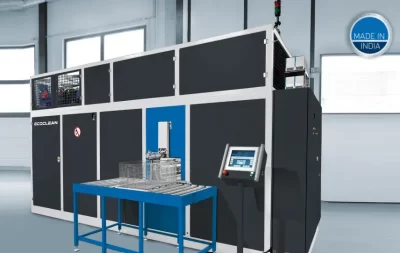
Its flexible configuration allows adaptation to different component geometries and contamination levels.
Read more: https://ecoclean-india.com/products/universal-81c/
Minio 85C
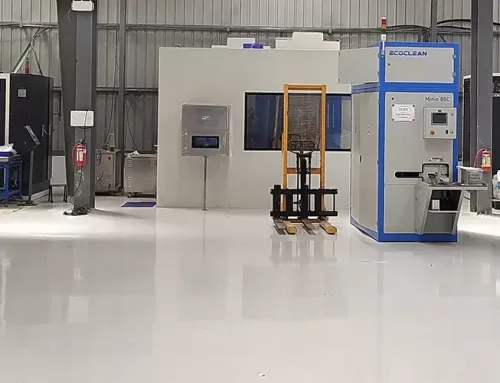
The Minio 85C is a compact solvent-based cleaning system, made in India, designed for small to medium batch production. It is suitable for:
- Precision-machined components
- Oil-intensive contamination
- Applications requiring controlled and enclosed cleaning
- Compact footprint
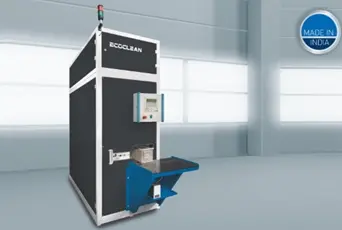
Read More: https://ecoclean-india.com/products/minio-85c/
Despite its compact footprint, the system integrates solvent recovery, filtration and vacuum drying, ensuring stable and repeatable cleaning results.
Both systems are engineered and manufactured in India to support local production requirements while maintaining global technical cleanliness standards.
Conclusion
The selection of cleaning technology must be based on contamination type, component characteristics and required cleanliness level. In applications dominated by oil contamination, rust preventive oils, or components with porosity where complete drying is critical, solvent-based systems provide clear technical advantages.
Ecoclean’s solvent cleaning machines such as the Universal 81C and Minio 85C, deliver controlled, repeatable and residue-free cleaning with integrated solvent recovery and vacuum drying. When implemented as a process-controlled production step, they ensure stable downstream performance and reliable component quality.
Frequently Asked Questions
Q1. When is solvent-based cleaning preferred over other methods?
A. Solvent-based systems are preferred when removing stubborn oils and greases from complex geometries, especially where residue-free drying is required.
Q2. Are solvent cleaning systems environmentally compliant?
A. Modern closed-loop systems are designed with integrated solvent recovery and distillation, minimizing emissions and reducing solvent consumption.
Q3. Can solvent-based systems be integrated into automated production lines?
A. Yes. Modern systems are designed for automation compatibility and can be integrated into batch or inline production concepts.
Q4. What determines long-term cleaning stability?
A. Stable process parameters, effective filtration, solvent purity control, and controlled drying ensure consistent performance.